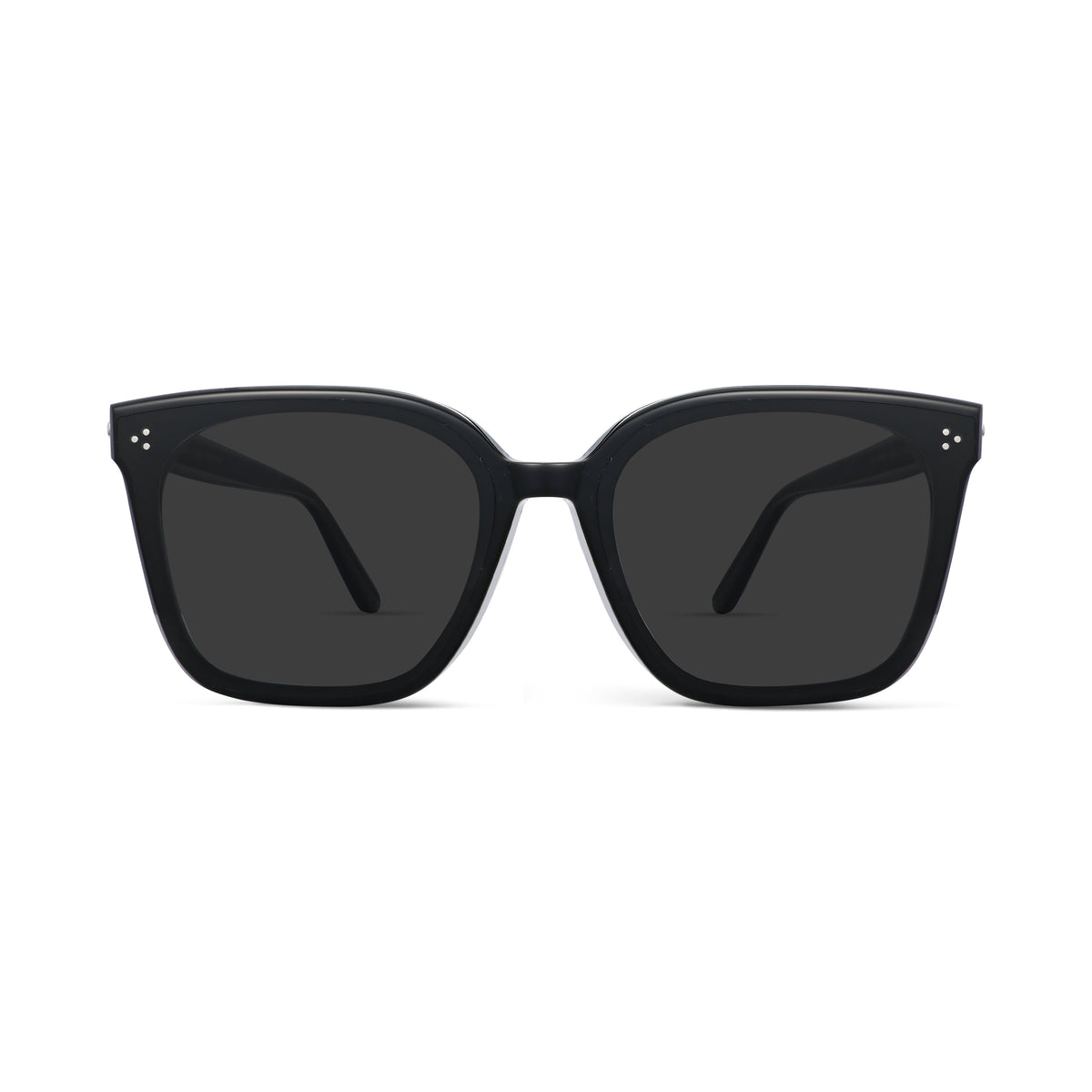
Short answer: look for a UV400 or 100 percent UV protection label first, then a lens tint that suits where you'll wear them, a frame that fits your face width and sits level, and hinges that feel firm when you open and close the arms. Polarized lenses are worth having if glare from water, roads or car windows bothers you. Price, brand and lens darkness tell you very little about protection.
The rest of this guide is a seven point checklist you can run in a store or on a product page, with what each point means and how to check it.
What to look for in sunglasses: the seven point checklist
1. UV protection on the label
This is the one point that protects your eyes, and it's the one you can't see by looking at the lens. The American Academy of Ophthalmology recommends sunglasses that block 99 to 100 percent of UVA and UVB rays. On a label or product page that reads as UV400 or 100 percent UV protection. If neither appears, assume the pair doesn't have it. The UV400 sunglasses guide explains what the number means.
Two things don't stand in for the label: a dark tint, and a high price. Dark lenses without UV protection can be worse than none, because your pupils open wider behind them. The are sunglasses bad for your eyes guide covers this.
2. A lens tint that suits how you'll use them
Tint is about comfort and contrast, not protection. Gray keeps colors true and works for most days. Brown and amber add contrast and warmth, which helps on cloudy days and for driving. Green sits between the two. Lighter tints suit city wear and low winter sun; very dark lenses suit beaches and snow. The tinted sunglasses and light tint sunglasses guides go through the colors, and mirrored and gradient lenses have their own guides.
3. Polarized, if glare is your problem
A polarizing filter cuts the flat, bright glare that bounces off water, wet roads and car windshields. It's the upgrade most people notice first when driving or near water. It doesn't add UV protection, so the label from point 1 still matters. It can make some phone and car dashboard screens look dark at certain angles. The what are polarized sunglasses guide explains how it works, and the how to tell if sunglasses are polarized guide has four quick tests.
4. A frame that fits your face
Fit decides whether you actually wear them. In the mirror, check that:
- the frame is about as wide as your face, with no gap at the temples and no pinching;
- your eyes sit near the center of each lens;
- the top of the frame sits at or just below your eyebrows;
- the frame stays put when you look down, and doesn't rest on your cheeks when you smile.
The three numbers on the inside of the arm (lens width, bridge width and arm length) let you compare a new pair with one that already fits. The glasses measurements guide explains them, and how should sunglasses fit walks through six checks. If frames often slide down or touch your cheeks, a low bridge fit frame, with a deeper nose bridge and longer nose pads, may sit better; the low bridge fit guide explains the feature.
5. A shape that suits your face and your wardrobe
Shape is taste, but a simple rule helps: frames that contrast with your face shape tend to balance it. Angular frames suit round and oval faces; rounder frames soften a square jaw. The what is my face shape guide helps you work out your shape. Oversized frames also block more light from the sides, which is why they're popular for bright days; see the oversized sunglasses guide.
6. Frame material and hinges
Pick up the pair and open and close the arms. They should move smoothly and stay where you put them. Loose or gritty hinges rarely get better.
- Acetate is cut and polished from a block. It feels solid and warm, comes in deep colors, and an optician can adjust it with gentle heat. See the acetate sunglasses guide.
- Metal and titanium frames are slim and light; titanium is the lightest and doesn't corrode. See the titanium sunglasses guide.
- TR90 is a flexible nylon that bends without snapping, which suits sport and travel.
- Spring hinges flex outward a little, so the frame keeps its shape longer. See the spring hinge glasses guide.
7. Returns and warranty
Even with every check done, a pair can look different on your face at home. Buy where you can return them, and check how long the warranty runs and what it covers. If you're buying online, read the size numbers on the product page before you order.
Not sure which size to pick? The how to measure for sunglasses guide turns your face width into a frame size and explains each number on a product page.
What not to pay extra for
A logo doesn't block more UV, and a darker lens isn't a safer one. Much of the price of a designer pair goes to licensing, retail margins and advertising, not to the lenses. The why are sunglasses so expensive guide breaks the price down. What's worth paying for is what you can check: the UV label, polarization if you need it, good hinges and a frame that fits.
MUJOSH pairs, checked against the list
MUJOSH has designed and made its own frames since 2010, so each product page states the lens, the frame material and the size numbers. A few examples:
- Cinnamon: oversized square acetate frame, polarized UV400 lenses, low bridge fit.
- Pearl-Accented: rimless frame with titanium temples and UV400 lenses.
- Numer: narrow rectangle in polished acetate with polarized lenses.
- Screwless Polarized: oversized square in screwless metal, polarized lenses, low bridge fit.
- Oatt Fold: foldable TR90 frame that packs flat for travel, UV400 lenses. See the foldable sunglasses guide.
Every pair comes with 30 day returns and a one year warranty.
The bottom line
Check the UV400 label first, choose the tint and polarization for where you'll wear them, and make sure the frame fits and the hinges feel firm. Those four checks matter more than the name or the price.
Frequently asked questions
What is the most important thing to look for in sunglasses?
UV protection. Look for UV400 or 100 percent UV protection on the label or product page. The American Academy of Ophthalmology recommends blocking 99 to 100 percent of UVA and UVB rays.
Are darker sunglasses better?
No. Darkness is about comfort in bright light. Protection comes from the UV filter, which can be built into light and dark lenses alike.
Should I get polarized sunglasses?
If glare from water, roads or car windows bothers you, yes. Polarization cuts that glare, but it doesn't replace UV protection.
How do I know if sunglasses fit?
The frame should be about as wide as your face, your eyes should sit near the center of the lenses, the top should sit at or just below your eyebrows, and the pair should stay put when you look down.
Are expensive sunglasses worth it?
Sometimes, for better lenses, hinges and materials you can see and feel. A higher price doesn't buy better UV protection, so a well made UV400 pair protects as well as a designer one.