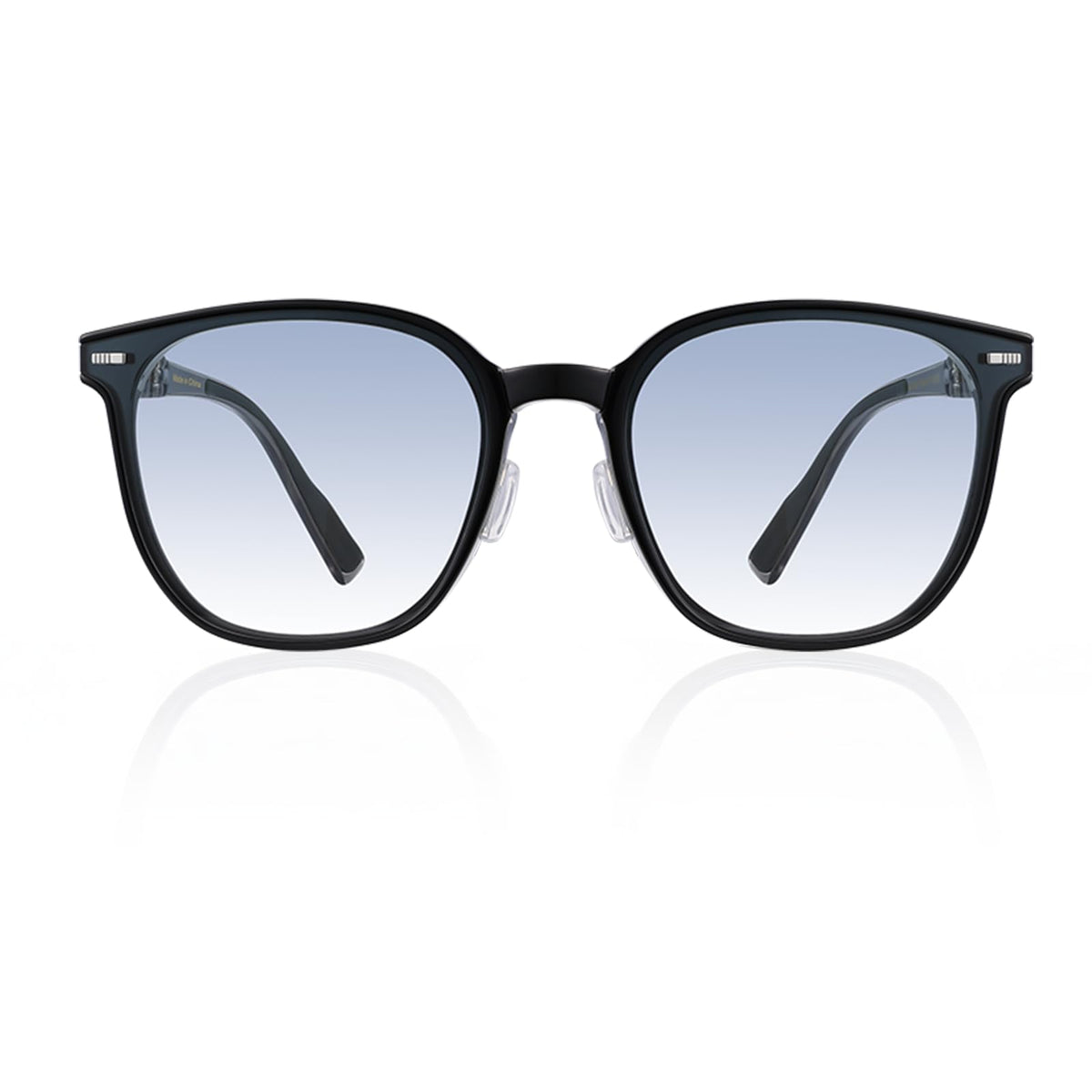
A folding frame is a trade, not a free upgrade. You gain a pair of sunglasses that fits in a jacket pocket or a glovebox. You give up some lens size, most wraparound coverage, and you add moving parts to the thing most likely to break. Whether that trade is worth it comes down to one question: how often do you leave sunglasses behind because carrying them is a nuisance?
What folding actually means
Every pair of glasses already folds once, at the hinges. A folding frame adds at least one more joint, and where the makers differ is how many.
Two fold. The temples fold as normal, and a single hinge in the middle of the bridge lets the two halves close together. This is the most common design and the most durable, because it adds exactly one moving part.
Three fold. The bridge hinge plus a second joint partway along each temple. The pack is meaningfully smaller and the frame is noticeably more complicated. This is where most travel specific designs sit.
Four fold and beyond. Impressive when folded, and the point at which the joint count starts to work against you. Every extra hinge is another thing to loosen, another gap for grit, and another place the frame can sit slightly crooked once it wears.
Counting the joints before you buy tells you more about how the frame will age than any material claim on the box.
Where a folding frame fails, and how to judge one
Ordinary sunglasses fail at the temple hinges or by scratching. Folding sunglasses fail at the bridge hinge, and they fail by developing play rather than by snapping.
Play is the word for the small amount of wobble a joint has when it should be rigid. A new folding frame has almost none. As the hinge wears, the two halves stop lining up, and the symptom is not a broken frame but a pair that sits visibly crooked on your face and will not adjust straight, because the misalignment is in the middle rather than the arms.
You can assess this before buying, and it takes about thirty seconds:
- Open and close it ten times. The motion should feel the same on the tenth as on the first. Gritty, loose or inconsistent means it is already worn or poorly made.
- Check that it stops. A good bridge hinge has a definite open position it settles into. If it drifts past flat, or has to be held straight, there is nothing holding alignment except friction.
- Hold the front and twist gently. Some flex is normal. A distinct click or a shift that stays is not.
- Look at the joint itself. Metal running on metal with a proper pin lasts. A plastic pin pressed into a plastic housing does not.
- Fold it and look at the lenses. They should not touch each other or press against the opposite temple. If they do, the frame is scratching itself every time it closes.
That last one is the most commonly missed, and it is the one that ruins a pair fastest.
What you give up
Three things, and being straight about them is the point of this piece.
Lens size. The frame has to fold into something smaller than itself, which caps how large the lenses can be. If you want a genuinely oversized shape, a folding frame is the wrong category. Oversized and folding pull against each other.
Wrap. A folding frame is almost always flat fronted, because a curved front cannot close cleanly. Wrap is what stops light and wind coming in at the sides, so a folding pair is a worse choice for cycling, driving into low sun, or anything at speed. If that is the use, the sport line is built the opposite way on purpose.
Simplicity. Every joint is a maintenance item. Not a dealbreaker, but a folding frame is a thing you look after slightly more than a normal one.
What you do not have to give up is lens quality. Folding says nothing about what the lenses do, and a folding frame can carry the same protection as any other.
When a folding pair is the right buy
The honest test is not whether folding sunglasses are good. It is whether you are the person who benefits.
Buy a folding pair if:
- You travel with a bag that is already full, and a rigid case is the thing that gets left behind.
- You want sunglasses in a jacket pocket without a bulge, or in a glovebox without a case sliding around.
- You keep losing or sitting on sunglasses because they live loose in a bag.
- You want a second pair that goes everywhere, rather than a primary pair.
Do not buy a folding pair if:
- You want one pair for everything and that includes sport or driving into low sun.
- You want a large or oversized shape.
- They will live on your head or around your neck, which is where the extra joints get stressed most and where compactness buys you nothing.
A folding pair earns its place as the pair you actually have with you. Judged as your only pair, it usually loses to something simpler.
The case matters more than you think
A folding frame with the wrong case defeats the entire purpose, and this is the most common way people waste the advantage.
If the supplied case is nearly the size of a normal sunglasses case, you have gained nothing: the case is what takes the space, not the glasses. A folding pair should come with a case sized to the folded frame, and the useful versions are small enough to disappear into a jacket pocket.
Hard, semi rigid and soft each make sense somewhere. Hard protects best and takes the most room. Semi rigid is the usual compromise and the one most folding frames ship with. A soft pouch protects against scratches but not against being sat on, which matters because the whole appeal is putting these somewhere they might be sat on.
One practical rule: whatever the case, keep the frame in it rather than loose in a pocket. Folded glasses have more exposed edges and more places for grit to work into a joint.
The Oatt Fold also comes with pink gradient lenses; the pink sunglasses guide explains what a pink tint does.
The MUJOSH Oatt Fold
MUJOSH makes one folding frame rather than a range of them, which is worth saying plainly: this is a single worked example, not a shortlist.
The Oatt Fold is a square metal frame that folds, currently $149. Metal is the right material choice here for the reason set out above: the bridge joint is the part that decides how a folding frame ages, and metal running on metal with a proper pin is what lasts. A folding frame built around plastic joints is where the category earns its poor reputation.
The square shape is a sensible pairing with folding too. It stays within the size a folding design can carry properly, rather than pushing toward an oversized look the format cannot support.
Folding frames often have fixed molded bridges with no adjustment, so how the bridge sits on your nose matters more here than on a metal frame with adjustable pads. Check it first.
The product page carries a SIZE AND FIT block with the frame's measurements. Comparing those against a pair you already wear comfortably is the most reliable way to size any frame online, and it matters more on a folding frame, where the shape is constrained by the format.
If a folding frame turns out not to be what you want, the rest of the range is in polarized sunglasses and the wider low bridge fit sunglasses collection.
A frame that folds in half is one of seven constructions in the unique sunglasses guide.
Frequently asked questions
Are foldable sunglasses less durable than normal ones?
They have more moving parts, so there is more that can wear. A well made folding frame with a metal bridge joint lasts a long time. A cheap one develops play in the bridge within months, and the symptom is a frame that sits crooked and cannot be adjusted straight. Judge the joint, not the brand.
How small do they actually get?
It depends entirely on the number of folds. A two fold design closes to roughly half its open width. A three fold gets considerably smaller. The number that matters is not the folded frame but the folded frame in its case, because the case is what you are actually carrying.
Are they good for cycling or running?
No, and this is the clearest case against them. Folding frames are flat fronted, so they do not wrap, and wrap is what keeps wind, grit and side light out. For anything at speed a wrap frame from the sport line is the right shape.
Do the lenses scratch each other when folded?
On a well designed frame, no, because the geometry keeps the lenses clear of each other and of the temples. On a poorly designed one, yes, and it is the fastest way to ruin a pair. Fold it before buying and look at what touches what.
Do folding frames work on a low nose bridge?
They can, but check the bridge specifically. Many folding designs use a fixed molded bridge with no adjustment, so if the shape does not suit your nose there is nothing an optician can change. A frame already cut for a lower bridge is the safer starting point. The low bridge fit guide covers what to look for.