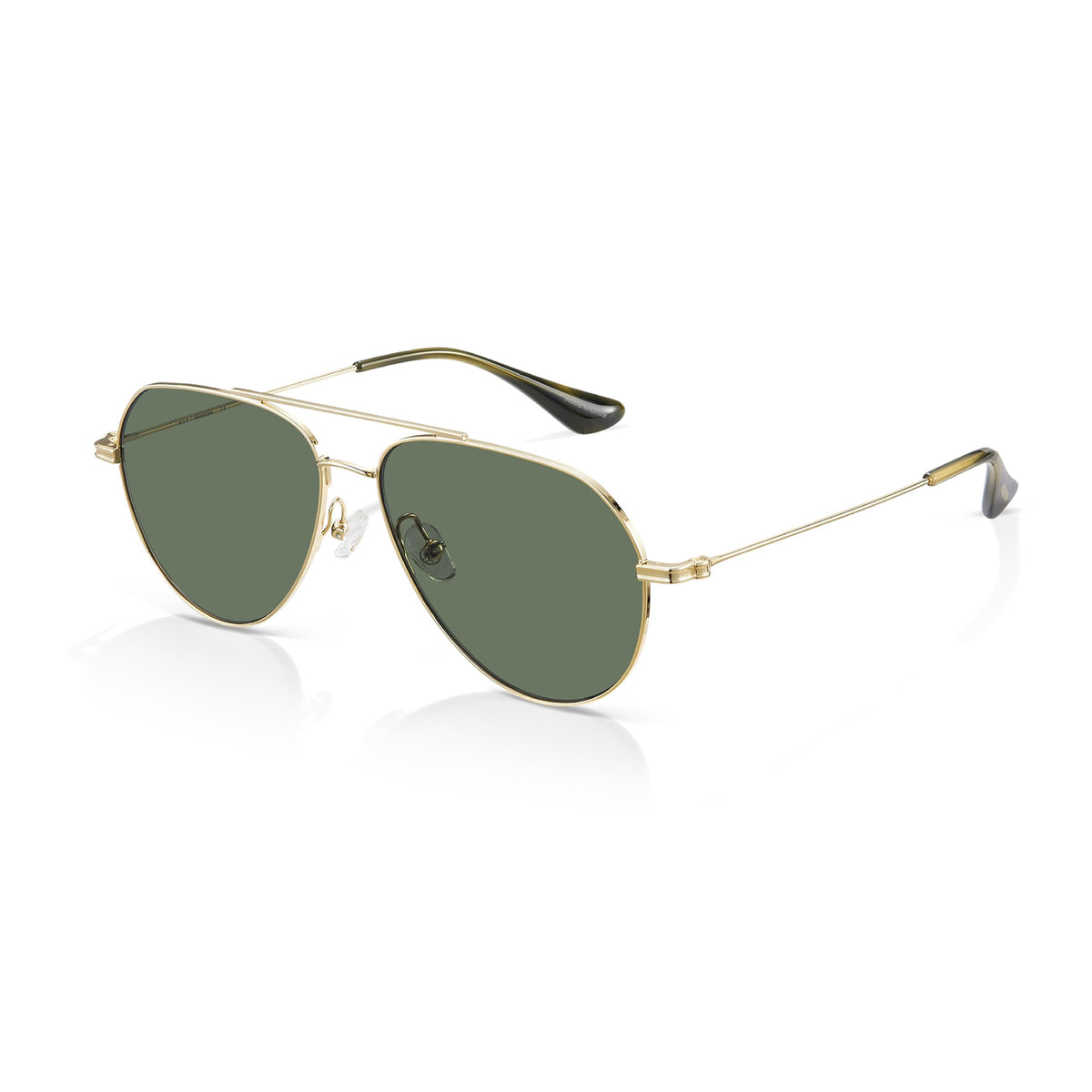
Reviewed by Feng (Leo) Chen, General Manager, International Business, MUJOSH. November 2026.
Short answer: to measure for sunglasses, hold a ruler across your face at eye level and measure from the outer edge of one temple to the other. Then pick a frame whose front width, listed on the product page as frame front or frame width, is within about 5 mm of that number. Check lens height and temple length next. The fastest way of all is to read the three numbers printed inside the arm of a pair that already fits you and shop for the same ones.
Sunglasses don't come in standard small, medium and large sizes, so the numbers are the only reliable guide when you buy online. This guide covers how to take each measurement at home, what each number on a product page means, and how to use them together.
Step 1: measure your face width
You need a ruler or a soft tape measure and a mirror.
- Stand facing the mirror and hold the ruler flat across your face, just under your eyes.
- Line up zero with the outer edge of one temple, where the arm of a frame would pass in front of the ear.
- Read the number at the same point on the other side. Write it down in millimeters.
That number is the width a frame front should roughly match. Within about 5 mm either way usually fits. With sunglasses, a frame a few millimeters wider is better than one that is narrower, because the lens should reach the sides of your face and block light from the side. A frame much wider than your face slides and looks oversized in a way that wasn't planned; the sunglasses for small faces and sunglasses for wide faces guides cover each end of the range.
Step 2: or copy a pair that already fits
If you own sunglasses or glasses that feel right, look on the inside of one arm. Most frames carry three numbers, for example 53 21 145:
- Lens width (53): how wide each lens is, in millimeters.
- Bridge (21): the gap between the lenses, where the frame sits on your nose.
- Temple length (145): the length of the arm, from hinge to tip.
Shop for frames within 2 to 3 mm of the lens width and bridge, and within about 5 mm of the temple length. The glasses measurements guide explains each number in more detail. One caution: sunglasses lenses usually run larger than eyeglass lenses, so a pair of glasses is a good guide for bridge and temple length but a looser one for lens width.
Step 3: read the five numbers on a product page
Many product pages, ours included, list more than the three printed numbers. Here is what each one tells you and how to use it.
| Measurement | What it is | How to use it |
|---|---|---|
| Frame front (frame width) | The full width of the front, hinge to hinge | Match it to your face width from step 1, within about 5 mm |
| Lens width | The width of one lens | Bigger lenses read bolder and cover more; compare with a pair you own |
| Bridge | The gap between the lenses | Decides where the frame sits on your nose; see the note on fit below |
| Lens height | How tall each lens is | Taller lenses block more light but sit closer to the cheeks |
| Temple length | The length of each arm | Too short pulls at the ears; too long lets the frame slide |
Frame front matters most. It is the number that decides whether the frame looks and feels right on your face, and it is the one the three printed numbers leave out. If a page lists only lens width and bridge, you can estimate it: two lens widths plus the bridge, plus about 6 to 10 mm for the hinges and outer edges.
Lens height is the sunglasses number. Glasses lenses are often 30 to 40 mm tall; sunglasses lenses commonly run 40 to 55 mm. A taller lens blocks more light from above and below, but if your cheekbones are high or the bridge sits low on your nose, a tall lens can rest on your cheeks when you smile. Under about 45 mm is the safer range if that happens to you.
Bridge and fit. The bridge number tells you the gap, not how the frame rests on your nose. If frames often slide down or sit on your cheeks, look for adjustable nose pads or a frame cut for a lower nose bridge; the sunglasses for a low nose bridge guide explains the difference.
How MUJOSH sunglasses measure
Every MUJOSH sunglass page has a Size and Fit panel with all five numbers, in millimeters and inches, plus a fit width scale. Across the current range, frame fronts run from 144 to 153 mm, and most sit between 148 and 150 mm. A few examples from the range:
- Cinnamon: 144 mm front, 52.8 mm lenses, 39.9 mm lens height. The narrowest front in the range and a shallow lens, for narrower faces or anyone whose sunglasses touch their cheeks.
- Retro Round: 145 mm front, 53 mm lenses, 150 mm temples. A compact front with long arms.
- Comte Oversized: 148 mm front, 64 mm lenses. Big lenses on a middle width front, which is how oversized can still fit an average face.
- Retro Aviator: 152 mm front, 60 mm lenses, 50 mm lens height. A wide, deep aviator for wider faces.
- Futuristic: 153 mm front, a one piece shield lens. The widest in the range.
Step 4: check the fit when they arrive
Numbers get you close; the mirror confirms it. Put the pair on and check that the frame is level with the sides of your face, your eyes sit near the center of each lens, the top of the frame sits at or just below your brows, and the pair stays put when you look down. The how should sunglasses fit guide walks through all six checks, and the what to look for in sunglasses checklist covers UV protection, lenses and hinges.
Frequently asked questions
How do I know my sunglasses size?
Read the three numbers inside the arm of a pair that fits you: lens width, bridge and temple length. If you have no pair to copy, measure your face width at eye level, temple to temple, and choose a frame front within about 5 mm of it.
What is a normal sunglasses size?
There is no standard, but most adult sunglasses have lenses of about 50 to 62 mm, a bridge of 14 to 22 mm and temples of 135 to 150 mm. Frame fronts commonly fall between about 135 and 155 mm. Small, medium and large labels vary by brand, so compare numbers rather than labels.
How do I measure my face for sunglasses without a ruler?
Copy the numbers printed inside the arm of a pair that already fits. Or hold a strip of paper across your face at eye level, mark it at each temple, and measure the strip later against any ruler or tape measure.
Should sunglasses be wider than your face?
Level with your face or a few millimeters wider. The lens should reach the sides of your face so light doesn't come in from the side. Much wider than that and the frame slides and looks too big.
Does lens height matter for sunglasses?
Yes, more than for glasses. A taller lens blocks more light, but if it rests on your cheeks when you smile it will fog, smudge and push the frame up. If that happens, choose a lens height under about 45 mm.