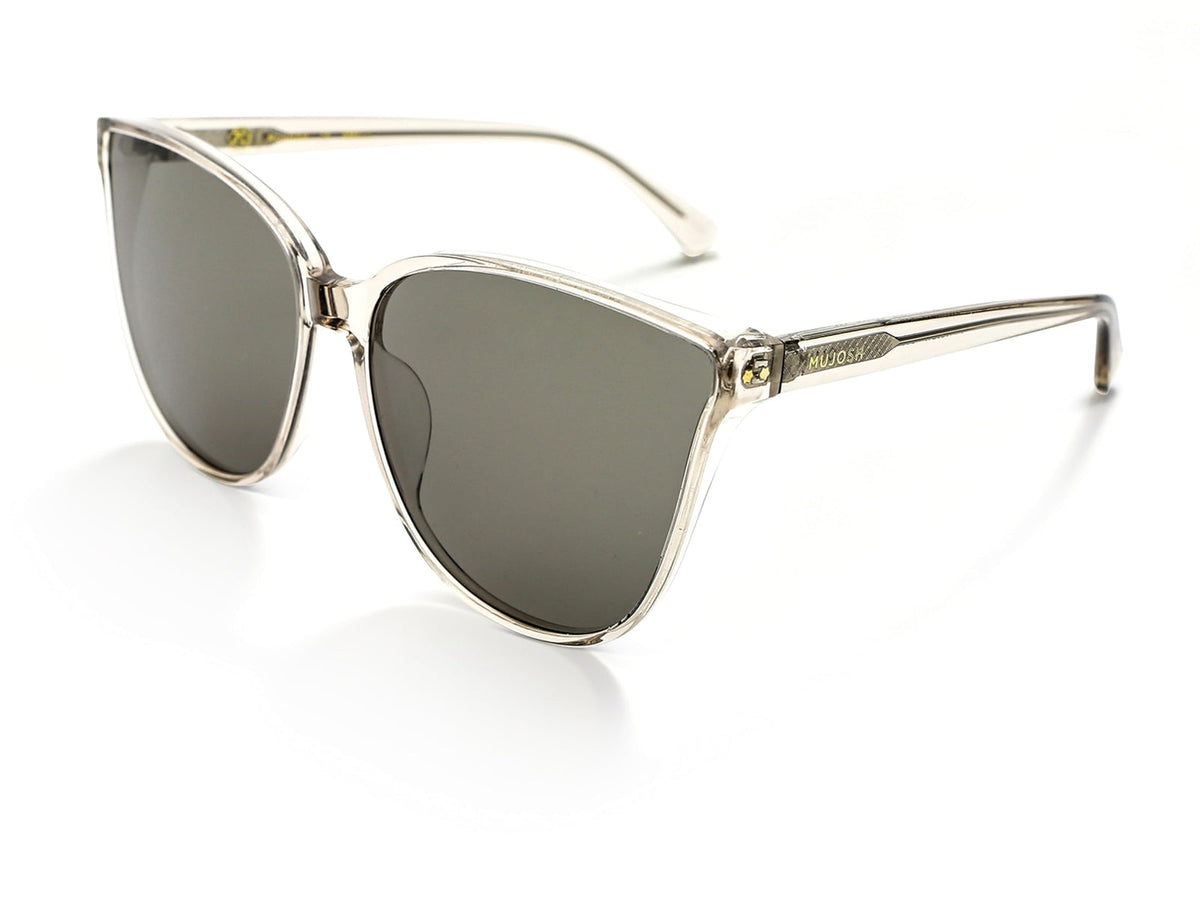
The difference is almost never the size of the lens. It is the width of the frame across the front, and whether that width matches the width of the face wearing it.
This is the one measurement that decides whether an oversized frame looks deliberate or borrowed.
Two different things get called oversized
Big lenses. A tall, deep lens that covers from brow to cheekbone. This is what people picture, and it is what fails most often, because a deep lens on a frame that is too narrow sits on the cheeks and leaves a visible gap at the temples.
A wide front. The frame reaches across to the outer edge of the face and the arms run straight back rather than angling outward to get there. The lens may or may not be especially deep.
The second is what makes a frame read as oversized in the way people actually want. A wide front changes the proportions of a face. A deep lens on a narrow front just puts more plastic in front of your eyes.
When a collection is built on lens depth alone, you get frames that look dramatic on a stand and wrong on a person. When it is built on frame width, the opposite.
How to tell whether a frame is wide enough for your face
You do not need a tape measure, and we are not quoting numbers here because MUJOSH's own size diagrams are still being prepared. You need a mirror and about ten seconds.
Put the frame on and look straight ahead.
Look at the corners. The outer edge of the frame should reach roughly to the outer edge of your face, or a little past it. If you can see your own cheek or temple beyond the edge of the frame, it is too narrow, and no amount of lens depth will fix that.
Look at the arms. From the front, the arms should run straight back towards your ears. If they splay outward to clear your temples before turning back, the front is too narrow and the frame is being stretched to fit. That frame will loosen quickly and will leave pressure marks in front of your ears.
Turn your head to the side. There should be a small gap between the arm and your temple, not pressure and not a wide gap.
A frame that passes those three is wide enough. Then, and only then, choose lens depth by preference.
The gap nobody mentions
Here is the thing that makes oversized frames behave differently from every other shape: they are heavier, and weight amplifies a bridge that does not fit.
A small frame with a slightly wrong bridge sits a little low and annoys you. A large frame with the same wrong bridge drops steadily through the day, lands on your cheeks, and is back down your nose within a minute of being pushed up. People conclude that they cannot wear big sunglasses. Usually they can, just not on that bridge.
If a frame rests on your cheeks when you smile, or marks your cheeks after an hour, or slides no matter how often you push it up, that is bridge fit, not size. A frame cut on a lower bridge pattern holds a large front in place because it is supported by the nose rather than balanced on it.
This is the specific reason many frames in MUJOSH's oversized collection are cut on a low bridge pattern. Large frames are where bridge fit stops being a detail and starts deciding whether you wear the pair at all.
Who oversized suits
Wider faces. The natural fit, and the group most often sold frames that are too small. A wide face in a standard frame makes the frame look undersized and the face look wider, which is the opposite of what the buyer wanted. Reach for width across the front first.
Smaller faces. Oversized works, but the frame has to stay within the width of your face or it will wear you. Look for a wide-looking shape in a narrower front, or a lens that is deep rather than broad.
Round faces. A square or rectangular oversized frame adds the structure a round face lacks. Avoid a large round frame, which doubles the curve.
Long faces. Deeper lenses help, because they break up the vertical length of the face. This is the one group for whom lens depth genuinely matters more than width.
Strong jaws. A softer oversized shape, rounded corners rather than sharp ones, keeps the frame from competing with the jaw.
What to look for in the build
Oversized frames put more strain on their own parts, so construction matters more than it does on a small frame.
Hinges. A wide front means more leverage on the hinge every time the arms open. Spring hinges absorb some of that. Screwless designs remove the part that most often works loose.
Where the weight sits. Pick a frame up by one arm and let it hang. If it tips sharply forward, most of the weight is in the front and it will slide more on your face. A frame that hangs closer to level is better balanced.
Material. Acetate gives the thicker front most people want from an oversized frame, and it can be reshaped by an optician if it needs adjusting. Metal keeps a large frame lighter and usually brings adjustable nose pads, which let you correct the fit rather than accept it.
Arms. On a wide frame, the arms should be straight and reach the ear without bending outward. Arms that curve out to clear the temples are a sign the front was not built wide enough to begin with.
An oversized square with a pink gradient lens is the classic version of the shape; the pink sunglasses guide covers the tints.
The best sunglasses for women guide covers which oversized frames suit which faces.
If the frame you need is long as well as wide, the sunglasses for big heads guide ranks the MUJOSH range by temple length and frame front and explains why spring hinges matter more than lens size.
For the opposite end of the scale, the small sunglasses guide covers the narrow frame and who should size up rather than down.
Practical notes
They are more exposed. A wide front means the outer corners of the frame stick out further than your face does, so they take the knock first on a doorframe or a car. A hard case is not optional with an oversized pair.
They fog more readily. A deep lens closer to the cheek traps warm air. Frames with any venting at the top of the lens clear faster.
They photograph larger than they look. A frame that seems slightly bold in the mirror is usually right in a photograph. A frame that seems perfect in the mirror often looks small in one.
If the oversized shape you want is a cat eye, the cat eye sunglasses guide covers how the upswept corner changes the fit.
Before you buy, run the six checks in the how should sunglasses fit guide; oversized frames pass or fail on the bridge and the cheeks.
On a long face oversized is the right size rather than a trend; the sunglasses for a long face guide explains why.
The oversized square started in the seventies, and the 70s sunglasses guide shows how to wear the original look now.
The oversized front is the first trait of the Korean sunglasses look, which the guide covers with the fit that keeps it on.
Oversized square sunglasses
The oversized square is the most worn big sunglass, because the straight top edge and the corners give a large lens some structure; without them a big lens reads as a mask. It suits round, oval and heart faces and should be approached with care on a square jaw, where a square-round, a square with softened corners, is the version that works. In the MUJOSH range the oversized squares are Comte Oversized in acetate, Lix in acetate with polarized lenses, Species BL as the square-round with spring hinges, and Screwless Polarized in metal; all four are cut for a lower nose bridge, which is what keeps a big square level. The square sunglasses guide covers the shape at every size.
Oversized round sunglasses
The oversized round is the late sixties shape, a lens so big it covers brow and cheek, and the softest of the big sunglasses. It suits square and angular faces best, because the curve softens the jaw, and oval faces take it at the right size; on a round face it repeats the curve and the oversized square is the better choice. The weight is the practical issue, because a big round lens in acetate is heavy, so the lighter materials matter here. In the MUJOSH range the oversized round is Ruvy Van, an oversized round in lightweight TR90 with polarized lenses, cut for a lower nose bridge, in white with a plum lens or black. The round sunglasses guide covers the shape at every size and the 60s sunglasses guide the decade it came from.
Oversized cat eye sunglasses
The oversized cat eye is the glamorous one: a big lens with a lifted outer corner, in acetate, that covers the brow and lifts the face at once. It suits round, oval and heart faces, and a version with a straight top line is the one for a round face, because the flat edge adds the line the lift alone does not. In the MUJOSH range the oversized cat eyes are Jasmin in Italian acetate with polarized lenses, Jasmin Straight with the straight top line, and Lvy Narrow, an oversized cat eye in lightweight TR90 with a one-piece bent lens; all three are cut for a lower nose bridge. The cat eye sunglasses guide covers the shape and the polarized cat eye sunglasses guide the pairs with the glare filter.
The oversized shape that is wider at the top than the bottom is the butterfly, covered in the butterfly sunglasses guide.
The optical version of the shape, and an honest account of where the MUJOSH frames stand on it, is the oversized glasses guide.
The oversized aviator, the teardrop that covers brow to cheekbone, is in the oversized aviator sunglasses guide.
Frequently asked questions
How do I know if a frame counts as oversized?
Look at the width of the front rather than the size of the lens. If the frame reaches to the outer edge of your face or a little beyond, and the arms run straight back rather than splaying out to clear your temples, it is oversized in the way that actually changes proportions. A deep lens on a narrow front is not the same thing.
Do oversized sunglasses suit small faces?
Yes, with one limit: the frame should not be wider than your face. A frame that extends past the outer edge of a small face will wear you rather than the other way round. Look for a shape that reads large through a deep lens rather than a broad front.
Are oversized sunglasses heavier, and does that matter?
They are heavier, and it matters mostly through the bridge. Extra weight makes a poorly matched bridge slide much faster, which is why people often conclude they cannot wear large frames. On a bridge cut to match the nose, the weight is carried rather than balanced, and a large frame stays put.
Why do my oversized sunglasses rest on my cheeks?
Because the frame is sitting lower than it was designed to. That is caused by a bridge cut higher or narrower than your nose, not by the lens being too deep. A frame on a low bridge pattern sits up where it belongs and keeps the lower edge clear of the cheek.