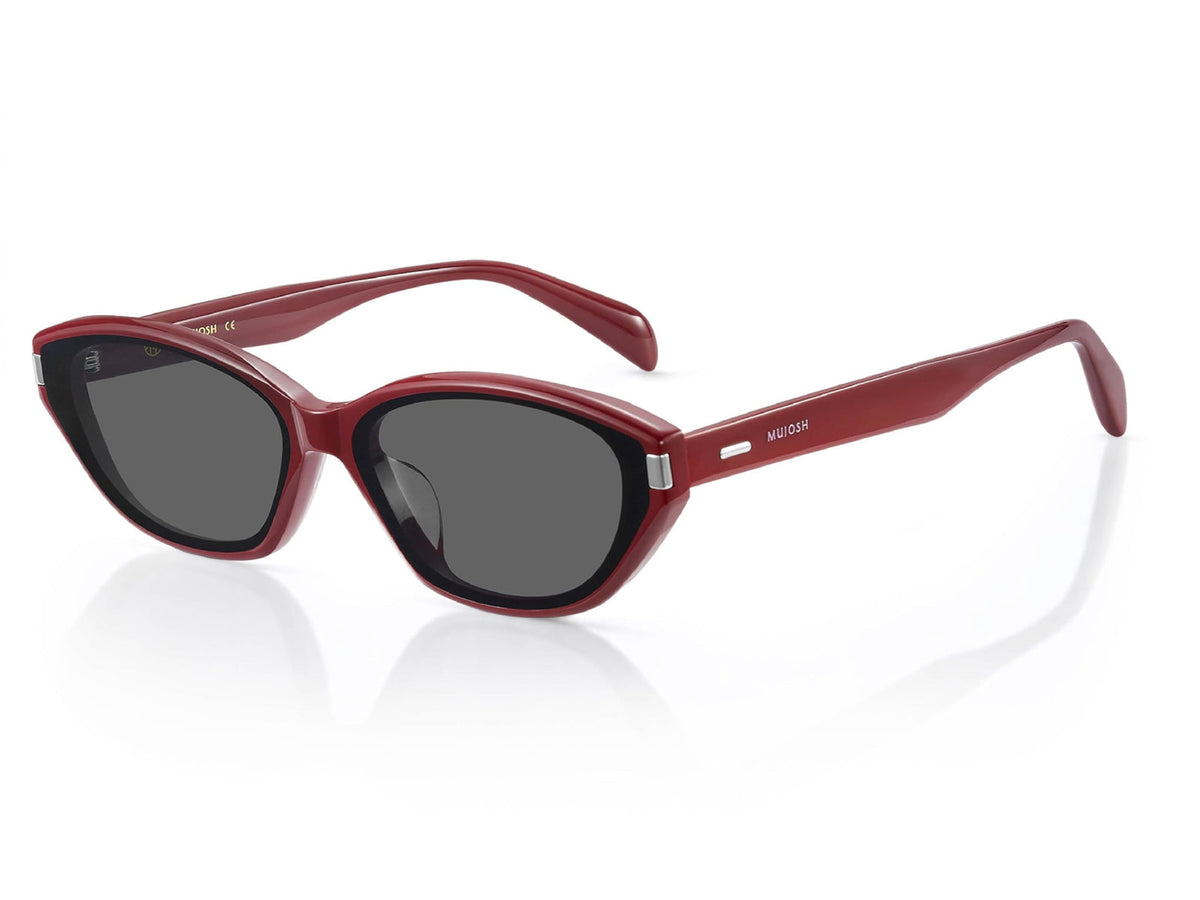
That is the whole idea. The outer corner of the frame rises above the line of the eye, and the eye follows the line up. It is the only common sunglass shape that does anything deliberate with the direction of a face.
Whether that suits you depends less on fashion than on two things: the shape of your jaw, and where the frame sits on your nose.
What actually makes a frame a cat eye
Three features, and a frame needs at least two of them to read as a cat eye rather than a rectangle with ambition.
The upsweep. The top outer corner sits higher than the top inner corner. On a strong cat eye the rise is obvious from across a room. On a subtle one it reads as a slight tilt, and most people could not name the shape but would say the frame "looks lifted".
A wider top than bottom. The brow line carries the weight. The lower edge of the lens is usually narrower and softer, which is what keeps the shape from looking like a mask.
A defined brow. Many cat eyes thicken the acetate along the top edge, so the frame draws a second eyebrow slightly above the real one. Metal cat eyes achieve the same thing with a browbar.
What a cat eye is not: any frame that happens to be pointy. A sharp rectangular corner is not an upsweep. If the top outer corner is not higher than the top inner corner, the frame is doing something else.
Who they suit
The honest version of this advice is that face shape guidance is a starting point, not a rule. Plenty of people wear the shape that theory says they should avoid and look better in it than the one theory recommends. Use this to narrow the shortlist, then look in a mirror.
Round faces. The strongest case. A round face has soft transitions and little angular definition. The cat eye supplies the angle the face does not have, and it puts it at the top, which draws attention upward and away from the widest part of the cheek. If you have been told round faces should wear angular frames, the cat eye is the least severe way to do it.
Square and heart shaped faces. Also good, for the opposite reason. A strong jaw or a wide forehead is balanced by a frame with a curved lower edge and its visual weight up top. Look for a softer upsweep rather than an aggressive point, or the frame competes with the jaw instead of balancing it.
Oval faces. Most things work. Choose on scale rather than shape: the frame should be about as wide as the widest part of your face, no wider.
Long faces. The shape that needs most care. A narrow, strongly upswept cat eye can make a long face look longer. A wider, flatter cat eye with more horizontal emphasis works better.
The part most guides skip: where it sits
A cat eye only does its job if it sits in the right place on the face. That depends on the bridge, not on the shape.
If the bridge of a frame is cut higher and narrower than your nose, the frame drops. Once it drops, three things happen at once. The upsweep, which was designed to sit just above the eye line, now sits level with it and stops reading as a lift. The lower edge of the lens lands on the cheek, so it marks the skin and fogs when you are warm. And you spend the day pushing it back up, which is the single most common complaint anyone has about sunglasses.
This is why two people can try the same cat eye and reach opposite conclusions about whether the shape suits them. It often has nothing to do with the shape. One of them has a frame that stays where it was designed to sit and the other does not.
If your sunglasses slide, the fix is a frame cut on a lower bridge pattern rather than a smaller frame. A smaller frame with the same bridge slides just as much, and now it is too small as well. MUJOSH cuts many of its frames on a low bridge pattern for exactly this reason, which is why the cat eye collection and the low bridge fit collection overlap.
Choosing between acetate and metal
Both are common in cat eye. They behave differently.
Acetate carries a thicker brow, which is what most people picture when they think of a cat eye. Color runs through the material rather than sitting on the surface, so a scratch does not show a different color underneath. It can be warmed and reshaped by an optician, which matters if you want the fit adjusted later.
Metal gives a finer line and a lighter frame. A metal cat eye reads as more restrained and tends to suit work settings better. Metal frames also usually carry adjustable nose pads, which means the fit can be corrected on your face rather than chosen off a shelf.
If you are unsure and you want one pair to do everything, metal with adjustable pads is the safer purchase. If you want the shape to be the point, acetate.
Lens color, briefly
Cat eyes are often bought for how they look, and then worn every day, so the lens matters more than the purchase decision suggests.
Gray keeps colors closest to true and is the least tiring choice for long wear. Brown and amber lift contrast, which most people find helpful in bright, flat light. Gradient lenses, darker at the top than the bottom, suit the cat eye particularly well because they follow the shape's own logic of weight at the top, and they let you glance down at a phone or a menu without lifting the frame.
Mirrored lenses sit oddly on a strong cat eye for most people, because the shape is already doing a lot.
For the optical version of the shape, the cat eye glasses guide covers how high the lift should go and which faces each lift suits.
For a shortlist by face shape and use, the best sunglasses for women guide ranks our cat eyes alongside the rest, and the retro sunglasses guide places the cat eye in its decade.
The cat eye is the first shape to try on a diamond face; sunglasses for a diamond face explains why and lists the pairs.
The cat eye is the shape most ranges go deep on in red, and the red sunglasses guide covers the shades from cherry to oxblood and who each suits.
Green on a cat eye reads as vintage, and the green sunglasses guide covers the shades from olive to bottle green.
For a round face the lift decides it; the cat eye glasses for a round face guide ranks nine MUJOSH cat eyes by how much they lift.
How to tell in thirty seconds whether a cat eye is working
Put the frame on and do not smile yet.
- Look straight ahead in a mirror. The top outer corner should sit above the line of your eye, not level with it.
- Check the width. The outer edge of the frame should be close to the outer edge of your face. If your face is visibly wider than the frame, the frame is too small and the upsweep will look pinched.
- Look down at the floor without moving your head. If the frame slides, the bridge does not match your nose. Nothing else you change will fix that.
- Smile properly. If the lower edge of the lens lifts off your cheek and then lands back on it, the frame is sitting too low.
- Take them off and look at your nose. Two red marks on the sides means the bridge is too narrow. A single mark across the front means it is too wide and the whole frame is resting on one point.
Those five checks take longer to read than to do, and they catch almost everything.
Cat eyes are one of the best shapes for a round face; the guide to sunglasses for round faces compares the others.
For how the cat eye sits among this year's shapes, see sunglasses trends 2026.
A compact cat eye is the first shape to try on a smaller face; the sunglasses for small faces guide explains why, and which narrow frames to start with.
Cat eye and tortoise shell come from the same era and are the pairing the pattern is best known for; the tortoise shell sunglasses guide covers the shades and which lens to pair.
The small, narrow cat eye is one of four 90s shapes; the 90s sunglasses guide covers the rest.
The sharp cat eye is the first of the four sixties looks in the 60s sunglasses guide.
The polarized split of the shape, seven pairs with the glare filter, is in the polarized cat eye sunglasses guide.
The cat eye at full scale, oversized and tapered, is the butterfly; the butterfly sunglasses guide covers it.
The shape in its home colour, with the seven black pairs, is the black cat eye sunglasses guide.
Frequently asked questions
Which face shapes suit cat eye sunglasses?
Round faces benefit most, because the upswept corner adds the angle a round face lacks and draws the eye upward. Square and heart shaped faces also suit them, especially in a softer upsweep that balances a strong jaw or wide forehead. Long faces need the most care: choose a wider, flatter cat eye rather than a narrow strongly pointed one.
What is the difference between a cat eye and a regular frame with pointed corners?
A true cat eye has its top outer corner higher than its top inner corner. That rise is the defining feature. A frame with sharp corners but a level top line is a rectangle or a square, and it will not produce the lifting effect people buy a cat eye for.
Do cat eye sunglasses slide down more than other shapes?
Not because of the shape. Sliding is caused by a bridge cut higher or narrower than your nose, and it happens to any shape with the wrong bridge. It is more noticeable on a cat eye because the design depends on sitting at a particular height, so when it drops the shape stops working as well as feeling wrong.
Should I choose acetate or metal for a cat eye?
Acetate gives the thicker brow and the bolder shape, and it can be reshaped by an optician. Metal gives a finer, lighter line and usually comes with adjustable nose pads, so the fit can be corrected on your face. If the pair has to work for everything, metal is the safer choice; if you want the shape to be the point, acetate.