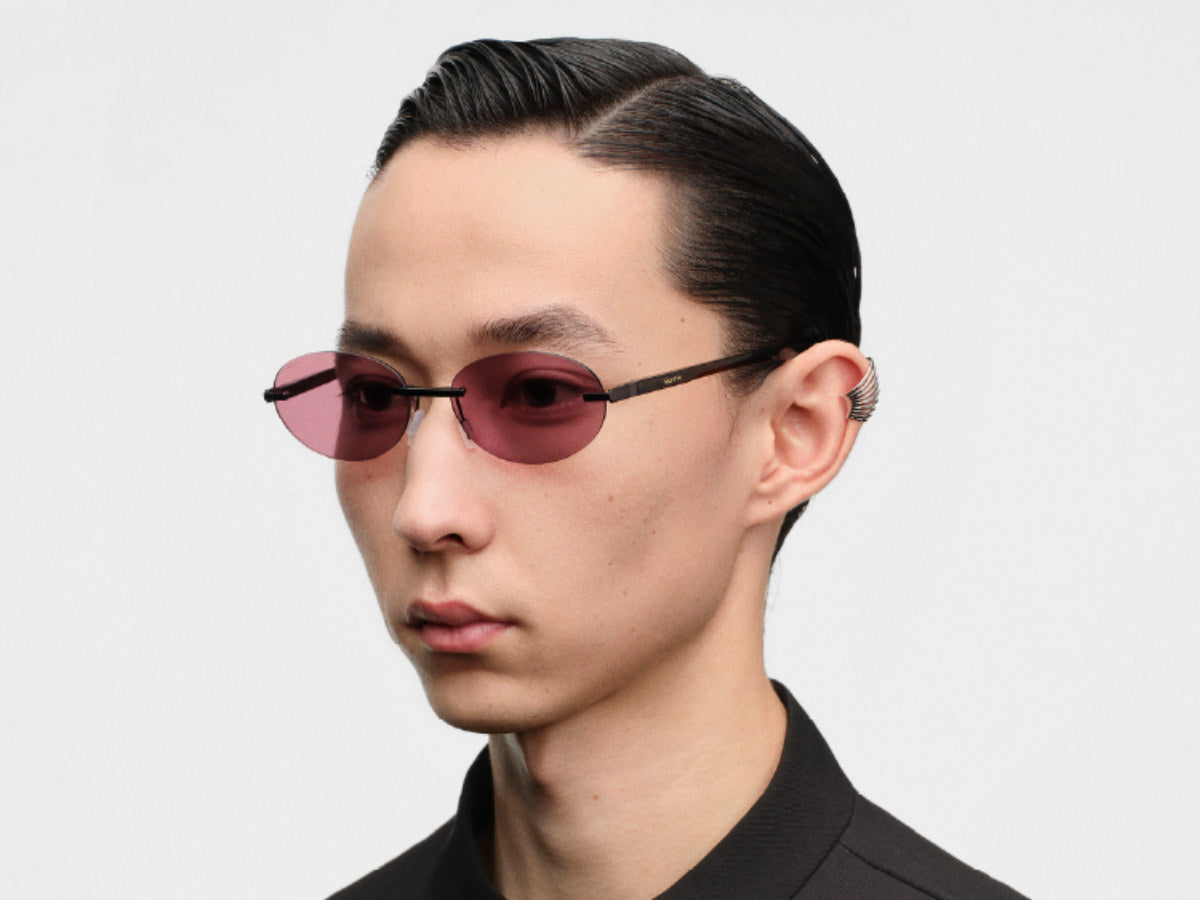
Why frames touch cheeks
Every pair of glasses is tilted. Look at a frame from the side and the lenses lean inward at the bottom, toward the face. Opticians call the angle pantoscopic tilt, and it exists for a good reason: the eye looks down more often than up, so tilting the lens keeps it at the right distance for reading and phone use.
The tilt is drawn for an average face, which means a nose bridge high enough to hold the top of the frame well clear of the cheekbones. On a face with a lower bridge, or higher cheekbones, the same tilt brings the bottom rim down onto the cheek. The frame is doing exactly what it was designed to do. It was designed for someone else.
Three things decide whether a frame clears your cheeks:
| Factor | What it does | When it causes cheek contact |
|---|---|---|
| Lens tilt | Leans the bottom of the lens toward the face | Tilt is too steep for the distance between your nose bridge and cheekbone |
| Bridge height | Sets how high the whole frame sits on the nose | Bridge is set high on the frame, so it floats above a lower nose and the frame drops until something stops it, usually the cheek |
| Nose pad angle | Sets where the weight rests | Pads are angled for a narrow ridge, so they sit on the sides of the nose instead of on it, and the frame slides forward and down |
The first is an adjustment. The second and third are design, and they are the difference between a standard frame and a low bridge fit one.
The three-second diagnosis
Put the glasses on, look straight ahead in a mirror, then do these in order.
- Press the frame gently up at the bridge. If the cheek contact disappears while the frame is held higher, the problem is bridge height: the frame is sitting too low on your nose. Go to fix two.
- Tilt the temples up at your ears so the bottom of the lenses moves away from your face. If the contact disappears now, the problem is tilt. Go to fix one.
- Smile. If the frame lifts off your nose when your cheeks rise, it is resting on the cheeks even when it looks clear. That is usually both problems together.
If none of the three changes anything, the frame is simply too deep for your face, meaning the lens is taller than the space between your brow and your cheekbone. No adjustment fixes that. Skip to the section on when the frame is wrong.
Fix one: reduce the tilt
Any optician can reduce pantoscopic tilt, and most do it free. The temples are bent slightly where they meet the front of the frame, so the lenses stand more upright. Two or three degrees is usually enough to lift the rim off the cheek without changing how the lenses focus.
Two cautions. Reducing tilt on a frame that also sits too low will lift the rim off the cheek but leave the lenses too far from your eyes, which shows up as a narrower field of clear vision through progressive or strong prescriptions. And on acetate frames the adjustment holds less well than on metal, because there is no hinge angle to set; the plastic is warmed and bent, and it relaxes back over weeks.
Do not do this yourself on an acetate frame. It cracks at the hinge.
Fix two: lower the bridge
If the frame sits too low on your nose, the frame's bridge is higher than your nose is. On a metal frame with nose pads on arms, an optician can bring the pads closer together and angle them to sit flat on the sides of your nose, which lifts the whole frame. It is a five-minute job and it is the single most common adjustment in an optical shop.
On an acetate frame the bridge is part of the front and cannot move. Some opticians will add stick-on silicone pads to raise the frame; it works, it is not elegant, and the pads wear out in a few months. If an acetate frame sits on your cheeks, the honest answer is that it is the wrong frame.
When the frame itself is wrong
Adjustments buy you two or three millimetres of lift. If the rim is resting on your cheek by more than that, or if the frame comes back down within days of every adjustment, the shape is wrong for your face and it will keep being wrong.
What to look for instead, in order of how much difference each makes:
- A bridge drawn lower on the frame, so the frame rests on the nose without being propped up by pads. This is the defining change in a low bridge fit frame.
- Less tilt built in, so the bottom rim stands further from the face at rest.
- A shallower lens, meaning less height from top rim to bottom rim, so there is simply less frame to reach the cheek.
- Pads angled for a wider, flatter nose on metal frames, or a wider, flatter bridge on acetate.
Every frame in the low bridge fit eyeglasses collection is built on those changes, and the low bridge fit sunglasses collection applies the same pattern to larger lenses, where cheek contact is the most common complaint of all.
If you are choosing between brands, the guide to fit labels across brands explains why the same frame carries different names, and what to check on a product page so the label is more than a label.
What smiling has to do with it
People are often told their glasses "fit fine" in the shop and then find them on their cheeks by lunchtime. The shop test is done with a straight face. Smiling raises the cheekbone by several millimetres, and if the frame's clearance is smaller than that, every smile pushes the frame up and every relaxation drops it back onto the cheek. Over a day that is hundreds of small lifts, which also explains why the frame ends the day lower on the nose than it started.
The test is simple and worth doing in the shop: smile broadly with the frame on. If it moves, it will move all day. This is also the quickest way to tell a genuine low bridge fit frame from one that only carries the name. Our piece on why glasses slide down covers the other reasons a frame creeps, since not all of them are the bridge.
For the other fit checks, from frame width to the fit behind your ears, see how should glasses fit.
Lenses that rest on the cheeks are often loose nose pads rather than the wrong frame; the how to tighten glasses guide shows how to move them.
Sunglasses have the same problem with deeper lenses; the sunglasses touching cheeks guide covers the four causes and ten pairs cut to sit on the nose.
Frequently asked questions
Why do my glasses touch my cheeks?
The bottom of the lens is tilted toward your face, or the frame's bridge sits too high for your nose so the frame drops until the rim meets your cheek. Both are properties of the frame, not your face, and both can be corrected or designed out.
Can an optician fix glasses that sit on my cheeks?
Usually, if the gap is small. Reducing the lens tilt or adjusting the nose pads lifts the rim by two or three millimetres. If the contact is larger than that, or the frame is acetate with a fixed bridge, the fix is a different frame.
Is it bad for glasses to rest on your cheeks?
It is uncomfortable rather than harmful, but it has two costs: the lenses fog and smudge from skin contact, and the frame gets pushed up with every smile, which wears the nose pads and leaves marks on the cheek by evening.
Do low bridge fit glasses stop cheek contact?
That is what they are designed for. The bridge sits lower, the lens tilt is reduced and the pads are angled for a flatter nose, so the frame rests on the nose with the rim clear of the cheek.
Will smaller glasses fix it?
Smaller lenses help only if the problem is lens height. If the bridge is the cause, a smaller standard frame sits just as low and touches the cheek in the same way. Check the bridge before the size.