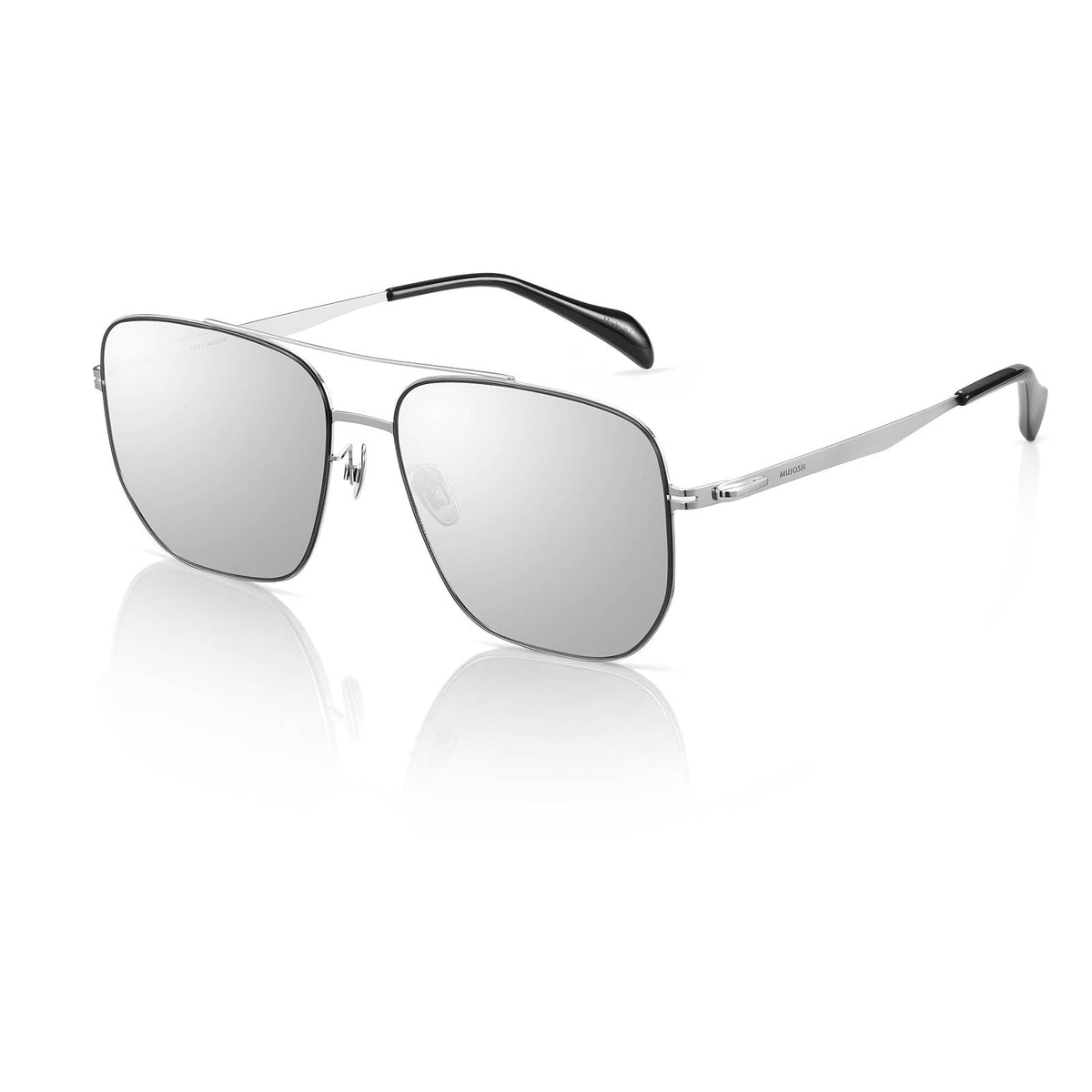
What makes a sunglass an aviator
The aviator was drawn for pilots in the 1930s, and the working parts of that design still define it.
- The teardrop lens. The top edge runs nearly straight along the brow. The lower edge dips lowest on the inner side, by the nose, and curves up toward the outer corner, so the lens covers the view when you glance down.
- The double bridge. A second bar crosses the frame above the bridge that sits on your nose. It stiffens a thin metal front and adds a straight line at brow level.
- A thin metal frame. Wire rims and slim temples keep the weight down, which matters with lenses this large.
- Nose pads on metal arms. Instead of a molded bridge, the frame rests on two pads that can be bent and angled to suit your nose.
A frame can drop the double bridge or the metal and still read as an aviator. It cannot drop the teardrop lens; without it, you have a square or round frame with a brow bar.
Why the teardrop shape works on most faces
Most frame shapes flatter one face and fight another. A round frame softens a square jaw but makes a round face rounder. A hard rectangle sharpens a round face but stretches a long one. The aviator mixes both kinds of line: a straight top, a curved outer edge and an angled lower edge. Every face finds something in it to echo and something to contrast.
The straight top sits along the brow, so it frames the eyes without adding a new line. The lower edge slopes inward toward the nose, which draws attention to the center of the face and away from the jaw. The double bridge adds width at brow level only, which balances a narrow chin.
| Face shape | What the aviator does | What to watch |
|---|---|---|
| Oval | Repeats the face's own balance | Only extreme size looks wrong |
| Round | The straight top and angled lower edge add structure | Choose a defined outer corner over a very soft teardrop |
| Square | The curved outer edge softens a strong jaw | Very thin wire can look slight on a broad face |
| Heart | The deep lower lens adds weight where the face narrows | Keep the brow bar thin, as the top is already widest |
| Long | The deep lens shortens the face and the brow bar adds width | Pick a deeper lens over a shallow one |
For the same exercise across every frame shape, see how to choose sunglasses for your face shape.
How to pick the right size
Size matters more than shape. An aviator that is too wide looks borrowed; one that is too narrow squeezes the temples and pushes itself forward on the nose. Three mirror checks settle it.
- Width. The outer edge of the frame should line up with the widest point of your face at the temples, or sit just outside it. A gap between the temple arm and your head means too wide. Arms that bow outward as they pass your temples mean too narrow.
- Lens depth. Smile. If the frame lifts because the lower rim rests on your cheeks, the lens is too deep for you or the frame sits too low. Aviator lenses are deep, so this is the shape's most common problem.
- Height. The top of the frame should sit at or just below your eyebrows. Covering the brows completely reads as oversized; a clear band of skin above the rim looks small.
Buying online, compare the measurements on the product page against a pair you already wear comfortably. Numbers beat photos. Every frame in the aviator sunglasses collection lists its own. If width is usually your problem, the guide to sunglasses for wide faces goes further.
Bridge and nose pads: the fit most people get wrong
The aviator depends on its nose pads more than most frames. There is no molded bridge to catch on the nose, so the pads carry the whole frame, with a large lens hanging forward of them.
On a higher nose bridge, a standard aviator rests where it was designed to. On a lower bridge, the pads meet the nose at the wrong angle, the frame drops, and the deep lens lands on the cheeks. You see over the top of the tint when you look up, and the frame bounces every time you smile. The piece on glasses touching your cheeks covers the detail.
There are two fixes. An optician can bend adjustable pad arms closer together and angle them flatter, which lifts the frame a little. A frame built on a low bridge pattern goes further: the pads are angled to lie flat against the sides of a lower nose, and the frame is shaped to keep the lens off the cheeks. What low bridge fit means explains the difference, and the low bridge fit sunglasses collection gathers frames built that way.
Metal or acetate
The classic aviator is metal, for good reasons. Metal keeps the rim thin, so a large lens does not become a heavy frame. It takes adjustable nose pads, which gives you the fit control described above. And a wire rim frames the eyes without covering the face, which is much of why the shape suits so many faces.
Acetate aviators suit a different wearer. The thicker rim gives the shape more presence, which can balance a broad face or a strong jaw that makes thin wire look slight. The trade offs are weight and fit: an acetate front is heavier, and its bridge is molded into the front, so it cannot be adjusted later. With a lower nose bridge, an acetate aviator has to be cut for it from the start.
If you are unsure, start with metal. It is the more forgiving build, and the metal frame glasses collection shows the range of rims and finishes.
Lens choices
Tint color changes how the world looks, not how much UV reaches your eyes. Those are separate specifications, so check the UV rating in the product details whatever the color.
- Gray. Darkens everything evenly and keeps colors true. The best all purpose choice.
- Green. A little warmer than gray, with slightly more contrast. Olive green in a metal frame is the original aviator pairing.
- Brown. Adds contrast and makes shadows easier to read on changeable days.
- Gradient. Dark at the top, lighter at the bottom, so you can read a dashboard or phone below the tint. A natural match for a deep lens.
Polarization is a separate question. A polarized lens cuts glare off water, wet roads and car hoods, which makes it the right default for driving and time near water. It can also black out phone screens and dashboard displays, which is why pilots are generally advised against it: a small irony for a shape named after them. The full case is in polarized vs non polarized sunglasses. None of the four MUJOSH aviators lists polarized lenses in its details, so if you want polarization, browse the polarized sunglasses collection.
How to wear aviators
Aviators carry associations: pilots, soldiers, film stars. To keep them current rather than costumed, let the frame be the only reference.
- Match the metal to what you already wear. Gold tones sit well with gold jewelry and warm colors; silver and gunmetal suit steel watches and cool colors.
- Keep the rest simple. A thin metal aviator works with a plain T-shirt, a shirt or a tailored jacket. Add a flight jacket and cargo pants and it tips into costume.
- Wear them high. The top rim belongs near your brow. Worn low on the nose, aviators look careless and put your eyes at the top edge of the lens.
- Do not park them on your head. It stretches the temples and loosens the pads, the fastest way to turn a good fit into a sliding one. Use the case, or hook one temple into a shirt placket.
The aviator appears in three more guides: the best sunglasses for men shortlist, the retro sunglasses guide for its seventies roots, and the mirrored sunglasses guide for the silver lens version.
The flat top aviator, a straight top bar over the teardrop lens, is covered with the other straight brow shapes in the flat top sunglasses guide.
The grey-green lens the aviator was built around has its own guide: green sunglasses, lens and frame.
The MUJOSH aviators
The aviator sunglasses collection is small: four frames, all metal.
- Aviator Total. The classic teardrop lens and double bridge in a thin metal frame, with gray lenses, adjustable nose pads and a low bridge fit, in four colorways.
- Retro Trendy. A classic metal aviator with balanced temples, adjustable nose pads, gray lenses and a low bridge fit, in three colorways.
- Geometric Polygon. A polygonal front in place of the curved teardrop, gray lenses, weighted temple tips to stop it tipping forward, and a low bridge fit. The angular front suits rounder faces.
- Retro Aviator. A classic metal aviator with balanced temples, adjustable nose pads and solid olive green lenses.
If you have a lower nose bridge, the first three are cut for it.
Two related reads: round sunglasses, the aviator's softer cousin, and the 2026 sunglasses trends piece for where the shape sits this year.
On an oval face the aviator is one of four shapes that work; the sunglasses for an oval face guide covers the other three and the width check that decides it.
On a square face the aviator is one of the two best shapes, because the teardrop lens is tall and curved at once; the square face guide explains why.
The hexagonal aviator is the current take on the shape; the hexagon and geometric glasses guide covers it alongside the optical versions.
How should aviators fit
Aviators fit when the top bar sits level with or just below the brows, the eyes sit in the upper half of each lens, the lower edge of the teardrop clears the cheeks when you smile, and the front reaches the sides of the face at the temples without the lenses showing beyond it. The nose pads do most of the work: set them so the frame rests on the nose rather than the cheeks, and the lens height follows. On a lower nose bridge a standard aviator slides until the lens rests on the cheek, which is why the Aviator Total and the Retro Trendy carry adjustable pads with a low bridge fit. If the top bar sits above the brows the frame is too deep for the face; if it pinches at the bridge with the pads fully open the frame is too narrow.
The aviator is the shape the 1970s made its own; the 70s sunglasses guide puts it beside the other three looks of the decade.
The silver aviator, in frame or in mirror lens, is covered in the silver sunglasses guide.
The aviator is the oldest metal sunglass; the metal frame sunglasses guide covers what metal does that acetate cannot.
Mirrored aviator sunglasses
The mirrored aviator is the eighties version of the shape: the same teardrop metal frame with a silver or blue mirror coating on the outside of the lens, which reflects light away, hides the eyes completely and reads as sport, summer and a little bit of attitude. It suits dark hair and strong features, which carry the shine, and it is the aviator for a beach or a boat rather than an office. The mirror is a coating, not a filter, so it does not cut glare off water the way a polarized lens does; the mirrored sunglasses guide covers the difference. In the MUJOSH range the mirrored aviators are Aviator Total in MSPG, a silver mirror on a metal aviator with adjustable nose pads and a lower bridge cut, and Geometric Polygon in SS, a silver mirror on the polygonal aviator with weighted temple tips and a low bridge fit; the 80s sunglasses guide covers the decade the look belongs to.
The shape at its biggest, with the four checks for how big is too big, is the oversized aviator sunglasses guide.
Frequently asked questions
Do aviator sunglasses suit round faces?
Yes. The straight top and angled lower edge add structure that a round face lacks. Choose an aviator with a defined outer corner, or a polygonal version, rather than a very soft teardrop, and make sure the frame is at least as wide as your face.
Do aviators look good on small or narrow faces?
They can, if the frame is scaled to match. Check that the outer edge lines up with your temples and that the lens clears your cheeks when you smile. A thin wire rim keeps the frame from overwhelming a small face.
Are all aviator sunglasses polarized?
No. Aviator is a frame shape and polarization is a lens option. Some aviators have polarized lenses and many do not, so check the lens details on the product page. Polarization is also separate from UV protection, which you should check on its own.
Why do my aviators rest on my cheeks?
Usually because the frame sits too low on your nose. Aviator lenses are deep, so when the nose pads do not hold the frame high enough, the lower rim lands on the cheeks. An optician can adjust metal pad arms, or you can choose a frame built on a low bridge pattern.
Are aviator sunglasses for men or women?
Both. The shape is unisex, and the fit rules are the same for everyone: frame width against the temples, a bridge that holds the frame at the right height, and a lens that clears the cheeks.
Does MUJOSH make polarized aviator sunglasses?
Not at the moment. The MUJOSH aviators, Aviator Total, Retro Trendy, Retro Aviator and Geometric Polygon, are sold with tinted or mirrored lenses rather than polarized ones, and this guide says so rather than implying otherwise. If the glare filter matters more than the teardrop shape, the polarized pairs in the range are squares and cat eyes: Maga KC is the metal flat top with flush-mount polarized lenses and nose pads, and the polarized sunglasses under $100 guide lists the rest.
How should men wear aviator sunglasses?
Get the size right first: the frame should be about as wide as your face, with the top rim at or just below the brows. Wear them high on the nose, not low. Gold metal with a green or brown lens is the classic; silver or gunmetal with a grey lens reads cooler and suits a steel watch. If they rest on your cheeks, the nose pads need adjusting or the frame needs a lower bridge cut.