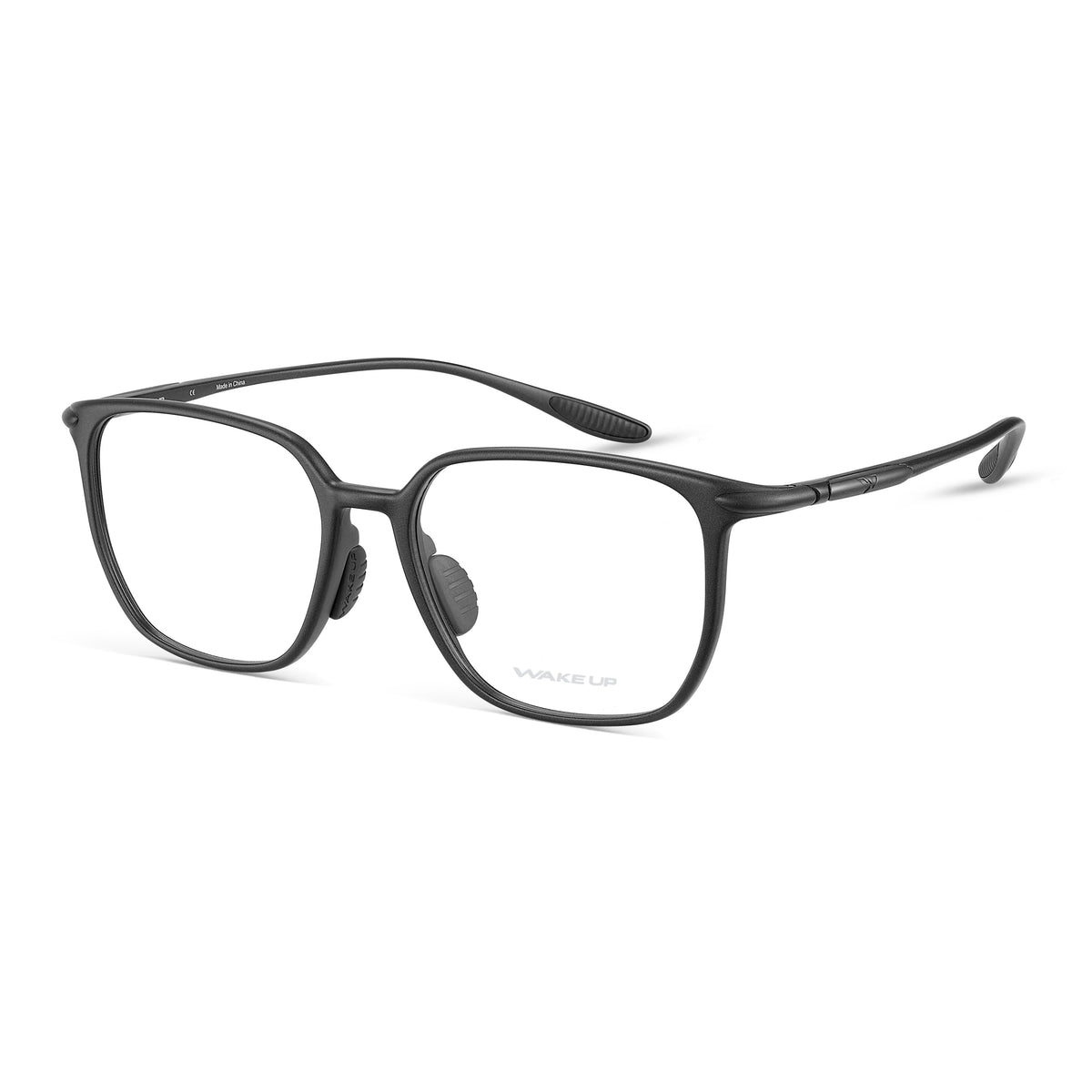
What counts as square glasses
A frame whose lens has a straight top line and corners the eye can see. Within that, three shapes get sold as square, and they sit differently on the face.
- Square. The lens is about as tall as it is wide, with corners that may be sharp or softened. Reads as strong and modern; the most structure a frame can add.
- Square round. A square front with its corners rounded until the eye reads a soft square. Half way to round, and the easiest square to wear, because the straight top line stays and the hardness goes.
- Rectangle. Wider than it is tall. The classic office frame, narrower and quieter on the face, and the one that most often ends up too shallow. The rectangular glasses section below covers it, and the square vs rectangle guide goes into the difference in detail.
The rule of thumb: the more a lens is square rather than rectangular, the more it adds height to the face; the sharper its corners, the more it adds structure.
Who square glasses suit
Contrast is the rule. A square frame adds lines, so it suits faces that have curves to balance.
A round face takes square frames best. The straight top line and the corners give the face the angles it lacks, and a square lens with real height lengthens a face that is as wide as it is long; the glasses for a round face guide puts square first. An oval face takes square frames easily, as it takes most shapes, and a square or rectangle in a thin rim is the sharpest look an oval face can wear; the oval face guide covers the size rules. A heart shaped face takes a square round or a rectangle with a thin top rim, which keeps the brow quiet. A long face takes a deep square, close to as tall as it is wide, because the height covers length and the straight line breaks it.
Beyond face shape, square frames suit anyone who wants the glasses to read as deliberate: a square frame in a medium rim is the single most recognisable "I chose these" look in eyewear.
The face to approach with care
A square face already has the lines a square frame adds. A sharp cornered square in a thick dark rim repeats the jaw and makes the face look harder and shorter; the glasses for a square face guide explains the mirror effect. That face is not barred from square frames, but it wants the softened version: a square round, a thin rim, rounded corners and enough lens height. If the choice is between a sharp square and a round frame, the round glasses guide is the one to read.
Rectangular glasses
Rectangular glasses are the square frame's wider, shallower cousin and the most common frame in the world, which is also the problem with them. A rectangle in a thin rim sits quietly on an oval or round face and reads as professional, and a wide rectangle adds width to a long or narrow face. But a rectangle that is too shallow, the thin office slit, cuts the face in two, sits high and leaves everything below it on its own; on a long face it is the worst shape there is. The fix is height: choose a rectangle whose lens is at least two thirds as tall as it is wide, and the shape keeps its quietness without the slit effect. Rectangle frames with rounded corners are the soft version, and the version for a square face.
The width check that decides it
Square frames show a width mistake more than any other shape, because the straight top line and the corners are measuring sticks the eye reads at once.
Stand at a mirror and look straight ahead. The outer corners of the lenses should sit level with the sides of the face, where the temple arm begins its run back. Corners past the face read as too big, and a square frame past the face reads as a box; corners well inside the face read as small and make the face look wider by contrast. Then look at height. The top line should sit just under the brow with the eyebrow visible, and the lens should come down toward the cheekbone without resting on it. A square lens is deeper than a rectangle of the same width, so check that it clears the cheek when you smile. The how glasses should fit guide has the full seven checks.
Rim and colour
The rim turns the same square into three different frames. A thin metal rim in a square or rectangle reads as precise and light, and it is the version for a square face and for anyone who wants structure without weight. A medium acetate or nylon rim is the modern default, enough presence to be seen as a choice, and it suits round and oval faces best. A thick, dark square rim is a statement, and it works on a face with the width and the cheekbones to carry it; on a small or square face it swallows the features.
Colour follows the rim. Black square frames are the strongest line a face can wear; tortoise softens the same shape; clear and translucent square frames keep the structure and drop the weight, which is why a clear square works on faces a black square does not. Grey, navy and brown crystal sit in between.
Fit: a square frame has to sit level
A straight top line shows a tilt at once, and a square frame that slides down the nose drops its corners toward the cheeks and reads as both too low and too wide. The frame has to sit level across the brow and stay at the height it was drawn for. On a lower nose bridge that means a frame cut to sit lower, with pads set to hold it; many of our frames are made that way, and the low bridge fit eyeglasses collection lists them.
Square glasses for women and men
The shapes hold for both. On a man's face a square or rectangle in a medium dark rim is the default for a reason, and a square round in nylon or acetate is the current version; a thin metal rectangle is the quiet office choice. On a woman's face a square in a thin rim or a translucent colour reads sharp and light, and an oversized square in a medium rim adds structure to a soft face without hardness. In both cases the width check comes before the colour.
MUJOSH square and rectangular glasses
Four frames from the eyeglasses collection cover the shapes above, verified from the product photos.
- Kubo 1062 from the WAKE UP line: a square nylon frame cut for a lower nose bridge, three colorways including a frosted clear, $135. The square option, with the height a round or long face wants.
- Beta Pitot: a square round with beta titanium temples and a low bridge fit, two colorways, $135. The softened square, and the one for a square face.
- Ego KC1063 from the WAKE UP line: a rectangle in nylon with softened corners, three colorways, $135. The everyday rectangle with enough lens height to avoid the slit effect.
- Evan BR1060 from the WAKE UP line: a narrower rectangle in nylon, three colorways, $135. The quiet rectangle for a smaller or narrower face.
If the frame you are weighing is wider than it is tall, the rectangle glasses guide covers that shape, who it suits and how to size it.
A square with its corners kept sharp sits at the quiet end of the geometric family; the geometric glasses guide covers the rest of it, from hexagons to multi-cuts.
The bottom line
Square glasses add lines, so they suit faces with curves to balance: round first, then oval, heart and long. A square face takes the softened version, a square round or a rounded rectangle in a thin rim. Choose square for height and structure, rectangle for quiet, keep the lens at least two thirds as tall as it is wide, check the corners against the sides of the face, and make sure the frame sits level, because a straight top line shows every mistake.
Black is the strongest colour for a square frame; the black frame glasses guide covers thick versus thin rims.
The square and the square-round are two of the four shapes in the glasses for men guide.
The men's half of this shape, with the three squares and the width rule, is in the square glasses for men guide.
Frequently asked questions
What face shape suits square glasses?
Round faces first, because a square frame adds the angles and height a round face lacks. Oval, heart shaped and long faces take square frames well too. A square face should choose a softened square, a square round or a rounded rectangle in a thin rim.
Are square glasses in style?
Yes. Square and square round frames in a medium rim are the current default for both men and women, and clear and translucent square frames are the newest version. The thin rectangle is the classic office frame and never leaves.
What is the difference between square and rectangular glasses?
A square lens is about as tall as it is wide; a rectangle is clearly wider than it is tall. Square adds height and structure, rectangle reads quieter and narrower. The common mistake with a rectangle is choosing one too shallow.
Can a round face wear square glasses?
Yes, and it is the first shape to try. Choose a square or a rectangle with real lens height and visible corners, in a medium rim, with the outer corners level with the sides of the face. A square round works too if the corners stay visible.