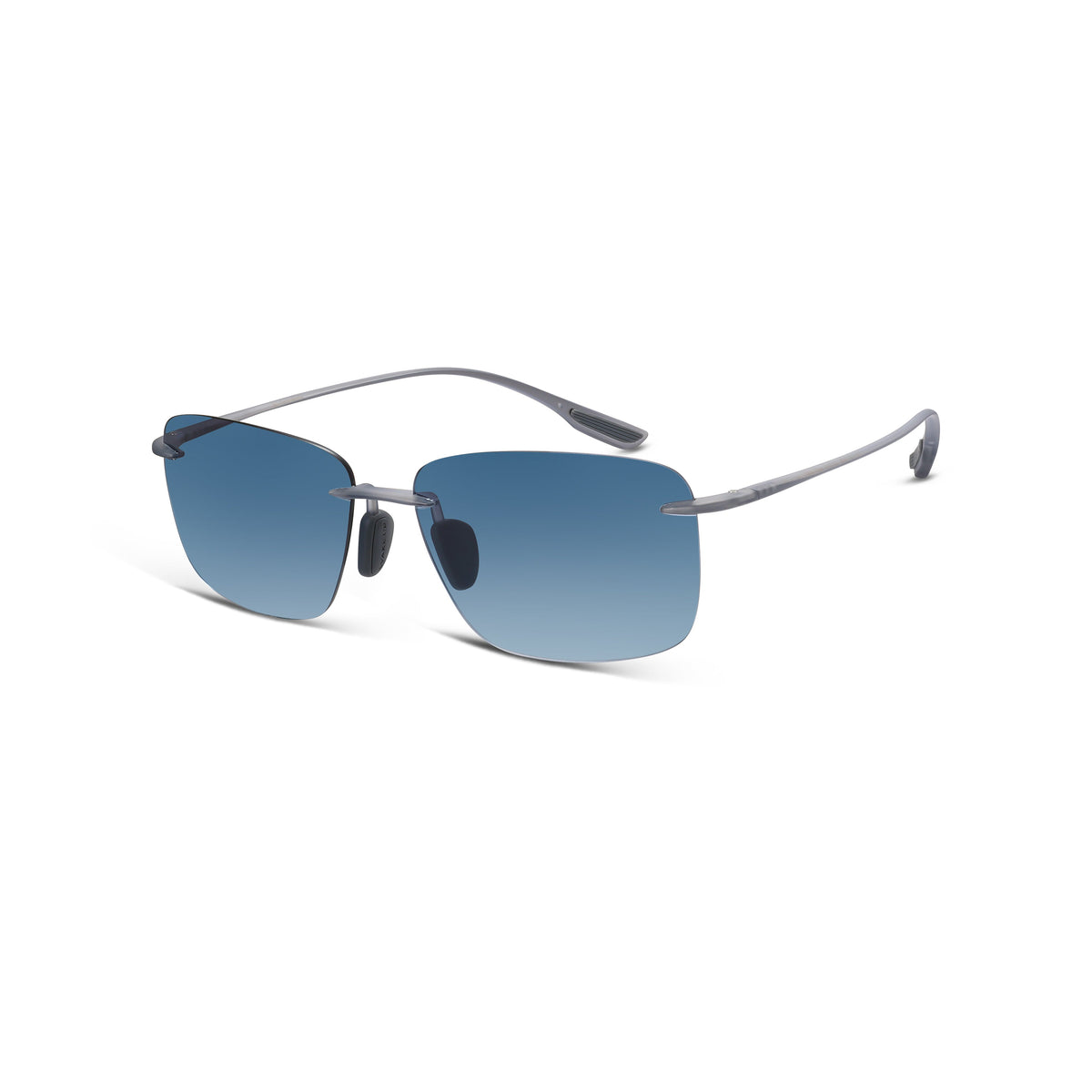
What rimless actually means
A full rim frame surrounds each lens with a ring of acetate, metal or nylon. A rimless frame has no ring at all: the bridge and each temple attach straight to the lens, either through a mount at the edge or, on a shield, to the ends of a single lens. A semi rimless frame keeps a rim across the top and leaves the bottom edge of the lens bare, which gives some of the rimless look with a conventional brow line. "Frameless" is just another word for rimless.
Sport shields blur the line. A shield sunglass with no rim and the temples fixed to the lens ends is rimless in every sense, which is why several of the rimless frames MUJOSH makes sit in the WAKE UP sport line rather than the fashion range. The types of glasses frames guide puts rimless in context with the other frame styles.
What you gain
Weight. The rim is a surprising share of a frame's weight. Take it away and what is left is two lenses, a bridge and two slim temples. On a long day in the sun, and especially on a hike or a ride, that is the difference you notice first.
Less frame on your face. Rimless frames show more of your face and less of the glasses. People who find full rim sunglasses heavy looking, or who want a pair that reads as understated rather than as a statement, usually land here.
Flexibility in the shape. Because there is no rim to mould, the lens can be cut to almost any outline. Rimless rectangles, shields with curved brows and open bottoms, and tall rounded squares all come from the same construction.
A clear lower view. With nothing along the bottom edge, there is no rim in the lower part of your sight line. Riders and runners notice this when they look down at a road or a trail, which is the same reason the shield sunglasses guide favours open bottom designs.
What you give up
The lens does the structural work. On a full rim frame the rim takes the knocks. On a rimless frame the mounts sit in the lens itself, so a hard drop or a careless twist loads the lens edge. Good rimless frames use tough lens materials and well made mounts, and most survive years of use, but they are not the pair to toss loose into a bag with keys.
Adjustment is in the pads and temples, not the rim. An optician can reshape a full rim frame in several places. On a rimless frame the fit is set by the nose pads and the bend of the temples, so those two parts matter more. The upside is that the pads are usually adjustable, which gives you more control than a fixed acetate bridge offers.
Edges show. The edge of the lens is visible all the way round, so a scratch along the edge or a chip at a mount is easier to see than it would be under a rim.
Thick lenses show. This matters less for sunglasses than for optical frames, but a thick lens with a bare edge looks and weighs more than the same lens hidden in a rim.
None of these is a reason to avoid rimless. They are the reasons to choose a pair carefully and treat it like the precision object it is.
How to judge a rimless pair
- Hold it by one temple and let it hang. The lenses should stay square to each other. A pair that twists out of line in your hand will twist on your face.
- Look at the mounts. The points where the bridge and temples meet the lens should be clean, tight and free of play. Wiggle a temple gently; the lens should not rock.
- Check the nose pads. They should sit on arms you can adjust, or on a pad that is shaped for your nose rather than a flat generic one. On a rimless frame the pads carry the fit. The nose pads guide covers what to look for and how to adjust them without stressing the frame.
- Check where the frame sits. With nothing around the lens, a frame that sits too low shows it immediately, because the bare lower edge lands on your cheek. If your current sunglasses slide or touch your cheeks, look for a rimless frame cut for a lower nose bridge; the low bridge fit sunglasses collection lists the MUJOSH ones.
- Read the measurements. Rimless frames list the same three numbers as any other frame, and total width still decides whether the pair suits your face. The glasses measurements guide explains how to read them.
Caring for rimless sunglasses
Three habits keep a rimless pair looking new. Take them off with both hands, so the temples are not levered against the lens mounts one side at a time. Clean the lenses with a cloth and lens cleaner rather than a shirt tail, because a bare edge picks up grit that then gets dragged across the lens; the cleaning guide has the full routine. And keep them in a case when they are not on your face, since a rimless lens edge against a zipper or a coin is how most rimless pairs pick up their first chip.
MUJOSH rimless sunglasses to start with
The rimless frames MUJOSH makes come from the WAKE UP sport line, which is where low weight and a clear lower view earn their keep. All four below use nose pads, and three are cut for a lower nose bridge.
- Murray 1024, $135. A polarized rimless rectangle with nose pads and slim temples, cut for a lower nose bridge, in four colorways. Listed under hiking sunglasses, and the pick if you want a rimless pair that still looks like an ordinary sunglass.
- Vanta 1025, $135. A polarized rimless sunglass with nose pads and slim temples, cut for a lower nose bridge, in three colorways. A slightly deeper lens than the Murray for brighter, more exposed days.
- Tidal Gradient 1020, $169. A fully rimless shield: one lens with no brow bar, the temples fixed to its ends, in a grip coated frame with four colorways. The most open view in the range, built for the bike; the cycling sunglasses guide covers what to check. Lens options are listed on the product page.
- Saga 1001, $127. Not a sunglass but worth knowing: a rimless rectangular optical frame with metal temples and nose pads, cut for a lower nose bridge, in four colorways, for anyone who wants the same construction in an everyday frame.
Both polarized pairs above also appear in the polarized sunglasses collection. Each product page lists the lens type, the colorways and the frame's own measurements.
Rimless is the lightest construction there is; the lightweight sunglasses guide compares it with TR90, PPSU and titanium.
A rimless sunglass adds no line at the cheekbone, which is why it suits a diamond face; the sunglasses for a diamond face guide covers the rule.
Pearl sunglasses
Pearl sunglasses are the dressed version of the rimless: a lens with no rim at all, so the detail moves to the temples, and a row of pearls along the temple is the detail that reads as jewellery rather than eyewear. The look suits an occasion, a wedding, a garden party, a summer dinner, and it suits fine features and a light frame, because the pearls are the only weight on the face. The lens should be a gradient or a light tint so the eyes show and the pearls stay the point. In the MUJOSH range the pearl sunglass is Pearl-Accented, a rimless diamond-cut lens on titanium temples with a pearl accent, polarized, with adjustable nose pads, in a lilac gradient or silver with grey; the wedding sunglasses guide puts it first for a bride.
The bottom line
Rimless sunglasses trade the rim for weight, openness and a clear lower view, and hand the rim's old jobs to the lens, the mounts and the nose pads. Choose a pair with tight mounts and adjustable pads, pick one cut for your bridge height, and treat the lens edges with a little respect. Do that and a rimless pair is the lightest, least noticeable sunglass you can own.
Rimless frames put every twist through the lens mounts, which is why the material matters; the titanium sunglasses guide explains what titanium changes and how to check a frame is the real thing.
Rimless is also one of the five early 2000s looks, which the Y2K sunglasses guide puts alongside the shield and the flat metal.
Rimless is the shape that dresses up most easily; the wedding sunglasses guide puts it first for a bride.
A lens with no rim is the quietest way to stand out; the unique sunglasses guide covers the six others.
Frequently asked questions
What are rimless sunglasses?
Sunglasses with no rim around the lenses. The bridge and the temples attach straight to the lens, or to the ends of a single shield lens, so the lens itself forms the front of the frame. Frameless means the same thing; semi rimless keeps a rim across the top only.
Are rimless sunglasses durable?
Good ones last for years. The lens edge and the mounts take the knocks a rim would normally absorb, so durability comes down to the lens material, the quality of the mounts and how the pair is handled. Taking them off with two hands and keeping them in a case makes more difference than with any other frame style.
Are rimless sunglasses good for a low nose bridge?
They can be, provided the frame is cut for it. Rimless frames rely on their nose pads for fit, and adjustable pads let you set how high the lens sits. A rimless frame on a pattern that is too high for your nose will show the problem quickly, because the bare lower edge of the lens lands on your cheek. Several WAKE UP rimless frames are cut for a lower nose bridge.
What is the difference between rimless and semi rimless sunglasses?
A rimless frame has no rim anywhere; a semi rimless frame keeps a rim along the top of the lens and leaves the bottom edge bare. Semi rimless gives a conventional brow line with some of the lightness and the open lower view of a fully rimless pair.
Can rimless sunglasses be adjusted?
Yes, at the nose pads and the temples. There is no rim to reshape, so the pads carry most of the adjustment, which is why adjustable pads matter more on a rimless frame than on any other. Temples can be bent slightly behind the ear in the usual way.
Which MUJOSH sunglasses are rimless?
Murray 1024 and Vanta 1025, both polarized rimless frames with nose pads cut for a lower nose bridge, and Tidal Gradient 1020, a fully rimless shield for riding. Saga 1001 is the rimless optical frame in the same line.