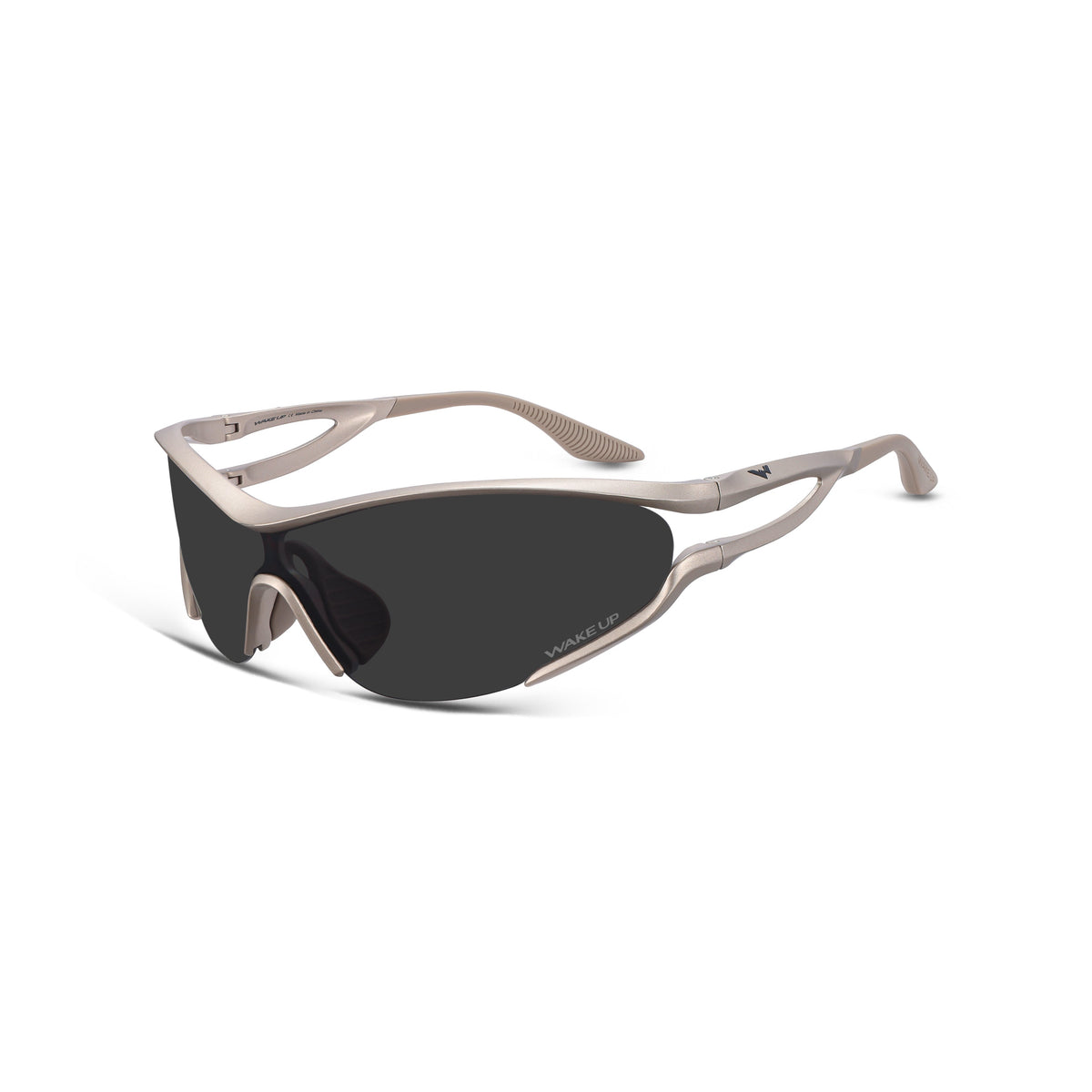
Coverage: why road glasses wrap
On a bike the air is moving even when the weather is still. At any real speed a flat frame lets wind curl around the edge of the lens and dry the eye, and it lets grit, insects and road spray in behind it. A cycling frame fixes this with curvature: the front bends around the face so the lens edges sit close to the temples and the gap above the cheek closes up. That is the difference between a sunglass that happens to be large and one that is cut for riding.
Two shapes do this well. A shield is a single lens that spans both eyes with no bridge cutting across the view, which is why it is the default shape for road riding. A wrap uses two lenses in a rim that curves back toward the temples, which gives a more conventional look with most of the same coverage. The guide to wraparound sunglasses explains the two in detail, and the shield sunglasses guide covers what a single lens changes about the view. Both shapes live in the wraparound sunglasses collection.
The check before you buy: put the frame on and look as far left and right as you can without turning your head. If you see the rim or the edge of the lens, the wrap is too shallow for riding in a group, where you spend a lot of time looking sideways.
The brow and the helmet
Road position puts your head down and your eyes up. A frame with a deep top rim or a thick brow bar ends up exactly where you are trying to look, and a helmet visor pushes it lower still. Cycling frames deal with this in two ways: they keep the brow bar thin or remove it, and they leave the bottom of the lens open so nothing crosses the lower view either.
Try this on the bike or on a trainer: get into the drops, look up the road and note whether anything sits in the top third of your view. If it does, the frame will annoy you on every descent. An open bottom shield, where the lens hangs from a slim brow bar with no lower rim, keeps that view clear.
Venting: why lenses fog on a climb
Fogging on a bike has a simple cause. Your face warms the air behind the lens, and when you slow down on a climb or stop at a light the moving air that was clearing it disappears. The lens cools faster than the air behind it, and the moisture condenses on the inside.
Three things help, in order of how much they matter. First, the gap between the lens and your face: a frame that sits a few millimeters off the cheek lets air pass behind it, which is why nose pads that lift the frame slightly often fog less than a frame pressed flat to the face. Second, vents: slots cut into the top of the lens or the brow bar let warm air escape as soon as you are moving. Third, an anti fog coating, which buys time but does not replace airflow. If a frame fogs standing still but clears within a few seconds of rolling, it is working as designed; if it stays fogged at speed, the lens is sitting too close to your face.
Why cycling glasses slip, and what holds them
A frame that slips on the bike is nearly always a nose problem, not a temple problem. Riding position tips the head forward, sweat reduces friction on the nose, and road vibration shakes the frame down a fraction at a time. The temples, which do most of the holding on a walk, do far less once the frame is tilted forward.
What holds a frame on the bike:
- Nose pads you can set. Adjustable pads let you set how high the lens sits and how wide the pads grip, which is the single biggest fit change available on a sports frame. The nose pads guide covers how to adjust them without bending the frame.
- Grip that gets grippier wet. Silicone pads and grip coated temple ends hold better once they are damp, which is the opposite of smooth plastic. Run a wet finger over the pads in the shop; if it slides, the frame will too.
- Low weight. A heavy front end swings forward on every bump. Nylon frames with a single lens are light enough that the pads do not have to fight the frame's own weight.
- A bridge that matches your nose. If a frame slides on a dry day with the pads set, the bridge is set too high for your nose and no amount of grip will fix it. The guide to why glasses keep sliding down walks through the checks, and several WAKE UP shields are cut for a lower nose bridge.
Test it the same way you would test a running frame: put the sunglasses on, drop your chin, and shake your head hard. If they move, they will move on the bike. The running sunglasses guide has the full bounce test, and it applies here unchanged.
Lens tint and polarization for the road
For most riding a medium gray or brown lens is the right default: dark enough for a sunny afternoon, light enough that a shaded lane does not go black. Riders who go out at dawn or ride under trees often keep a second, lighter lens, and a yellow or rose tint lifts contrast on a gray day. Mirror coatings cut glare a little further and hide your eyes, which some riders like in a group and some do not.
Polarized lenses are a judgment call on the bike. They cut reflected glare from wet asphalt and from car windshields, which makes them a real help on a bright day after rain. They can also make some bike computers and phone screens harder to read at certain angles, so if you ride with a screen, check it through the lens before you commit. The guide to polarized vs non polarized sunglasses explains the trade in detail, and the polarized sunglasses collection lists every MUJOSH frame with a polarized lens.
One point that gets confused: polarization is not the same thing as UV protection. Check that the product page states UV400 before you buy; the two specifications are separate.
WAKE UP cycling sunglasses to start with
WAKE UP is MUJOSH's sport line, and the frames below are the ones built for the bike. All of them use a lightweight nylon frame; they differ in lens shape, venting and how the fit is set. The full set is in the cycling sunglasses collection, and the wider WAKE UP sport line covers running, hiking and water.
- Suture Jacket 1096, $189. A polarized shield with adjustable nose pads, in three colorways. The pads are the point: set them once and the frame stays where you put it. This is the first pick if your current sunglasses slide.
- Touring 1035, $137. An open bottom shield that hangs from a slim brow bar, with two vent slots cut along the top of the lens for long climbs, in three colorways with a grip coated frame. The pick for riders who fog up or who ride low on the drops. Lens options are listed on the product page.
- Tidal Gradient 1020, $169. A rimless shield with no brow bar at all, the arms fixed to the ends of the lens, in four colorways with a grip coated frame. The most open view of the four. Lens options are on the product page.
- Flakx 1097, $169. A shield with adjustable nose pads, in two colorways, for riders who want the Suture Jacket fit in a slightly different shape.
Each product page lists the lens type, the colorways and the frame's own measurements, so compare the frame front width there against a pair you already own.
The bottom line
Pick coverage first, because a frame that lets wind in is wrong whatever else it does well. Then check the brow in your riding position, make sure the lens sits off your face enough to breathe, and set the nose pads before you judge the fit. Lens tint is the last decision, not the first. A frame that passes those four checks will disappear on the ride, which is the whole point.
Several of the shields above are fully rimless; the rimless sunglasses guide covers what that means for durability and care.
For a smaller face, the sport sunglasses for women guide explains why many sport frames sit too wide and what to check instead.
Frequently asked questions
What should I look for in cycling sunglasses?
Four things, in order: wrap coverage so wind and grit stay out at speed; a thin or open brow so nothing sits in your view when your head is down; venting or a small gap off the face so the lens clears on a climb; and nose pads with real grip so the frame holds over rough road. Lens tint comes after those four.
Are polarized sunglasses good for cycling?
Often, yes. Polarized lenses cut the glare off wet asphalt and car glass, which matters most on bright days after rain. The trade is that some bike computers and phone screens are harder to read through a polarized lens at certain angles, so check your own screen through the lens before you decide. Polarization is separate from UV protection; check the product page for the UV400 statement either way.
Why do my sunglasses fog up when I stop cycling?
Because the moving air that was clearing the lens stops when you do, and the warm air behind the lens condenses on it. Frames that sit a little off the face, and lenses with vents along the brow, clear again within seconds of rolling. A frame that stays fogged at speed is sitting too close to your face.
Why do cycling glasses slip down my nose?
Riding position tips your head forward, sweat reduces grip on the nose, and vibration shakes the frame down. Adjustable nose pads with silicone grip fix most of it. If the frame still slides on a dry day with the pads set, the bridge is cut too high for your nose and a low bridge fit frame is the answer.
Shield or wrap for road cycling?
A shield gives the clearest view, with no bridge across the middle and nothing in the lower view if the bottom is open, which is why it is the road default. A two lens wrap looks more like an ordinary sunglass and still blocks most of the wind. Mountain and gravel riders sometimes prefer a wrap for the extra rim protection; road riders mostly go shield.
Which MUJOSH sunglasses are made for cycling?
The WAKE UP shields in the cycling sunglasses collection: Suture Jacket 1096 and Flakx 1097 with adjustable nose pads, Touring 1035 with a vented open bottom shield, and Tidal Gradient 1020 as a fully rimless shield. All four use a lightweight nylon frame.